| SCION | |||||||
|---|---|---|---|---|---|---|---|
| a | b | c | d | e | Totals | ||
| S | A | 4 | 6 | 4 | 5 | 0 | 19 |
| T | B | 3 | 2 | 8 | 4 | 0 | 17 |
| O | C | 0 | 3 | 8 | 9 | 5 | 25 |
| C | D | 1 | 2 | 3 | 1 | 1 | 8 |
| K | E | 2 | 2 | 7 | 9 | 2 | 22 |
| TOTALS | 10 | 15 | 30 | 28 | 8 | 91 | |
Discussion After Dr. McKay's Paper
Dr. MacDaniels: "A good scion on chestnut is one problem which we have not solved."
Dr. Smith: "I find both Carr and Hobson difficult to graft and have discontinued them."
Dr. Crane: "In California and Oregon they are having quite a lot of difficulty with graft union failure with Persian walnuts. They have used the Northern California black or Hinds walnut as root stocks. Now they find that in some cases the union fails and results in what is known as the black line disease. At the present time this trouble is the most important cause of the loss of their trees."
Dr. Smith: "Zimmerman is a good bearing variety with a good nut. I find that soil makes some difference with this variety."
Breeding Chestnut Trees: Report for 1946 and 1947
ARTHUR HARMOUNT GRAVES[5]
The chief aim of this breeding work is the development of a chestnut tree of timber type to replace the now practically defunct American species, Castanea dentata. For the principal economic value of the chestnut was not in its edible nuts but its valuable timber, the loss of which means at present many millions of dollars subtracted from the assets of the American people; and when we consider the loss for all time in the future the figures become astronomical.
The Chestnut Blight in Italy. Early in 1946 we received a visit from Captain John B. Woodruff, of Wilton, Connecticut, who told us that while serving as Chairman of the Department of Agriculture and Forestry, and Instructor in Forestry at the Army University Study Center in Florence, Italy, he visited chestnut stands infected with the blight. Endothia parasitica was first discovered by Professor Guido Paoli in 1938 on a private estate in Busalla, about twenty miles north of the seaport city of Genoa. Since then the blight has been detected throughout the province of Genoa in the legion of Liguria; and other widely separated infections have been found. The fungus has been cultured and identified by Professor Biraghi of the Royal Pathological Station in Rome, as Endothia parasitica. It is believed to have been present in this region for from five to eight years previous to its discovery. The manner of its introduction into Italy is not known, but since Japan and the U. S. have carried on considerable commerce with Italy, either or both countries are possible sources.
The disease is spreading in Italy at a rapid rate. "By 1942 one half of the 190,000 acres of chestnut in the province of Genoa had been infected and spot infections had been discovered in the adjoining coastal province of La Spezia, also in the region of Liguria."
I am devoting some space to this situation because it means so much to the Italian people. In Italy fifteen percent of the forest is composed of chestnut. Not only does the country use the nuts as a source of food and income, approximately sixty million pounds being exported annually in former years, but the young coppice shoots are used for the weaving of baskets, older ones for poles for vineyards, still older for staves of wine casks, and the oldest for telephone and telegraph poles. "Before the war, chestnut flour was the principal food in many localities, but during the war a serious food shortage forced the people in many other areas to rely solely upon chestnut flour for weeks at a time."
Professor Aldo Pavari, Director of the Stazione Sperimentale di Selvicoltura at Florence, visited this country in the summer and fall of 1946, under the sponsorship of the UNRRA, and spent four days with me at our plantations, learning our methods and getting acquainted with the blight resistant hybrids we have been developing by the breeding together of oriental and native chestnuts. Prof. Pavari visited also the plantation of the Division of Forest Pathology at Beltsville and elsewhere, and other plantations in the west. In December we shipped to Florence, Italy, nuts of our best hybrids, and in March, scions for grafting—also this summer (1947) pollen of some of our best trees. On October 15 of this year (1947) we sent another shipment of nuts. Thus we may be able to give Italy the advantage of the progress we have made to date.
Regarding the susceptibility to the blight of the European or Spanish Chestnut (C. sativa) we have had the following experience. Our winter temperatures appear to be too severe for this species. Dying back is sure to occur, at least at our Hamden, Connecticut plantations, marked more or less according to the degree of cold; and on the dead parts Endothia then appears, to later invade the parts still living. In 1932 I received nuts of C. sativa from France from Professor Hochreutiner of the Geneva Botanic Garden, from Professor Uldrich of the Berlin Botanic Garden, and also from France from Dr. Guillaumin of the Jardin de Plantes at Paris. Although I have given the resulting plants much attention they continually die back each year so that we have only two or three individuals that are more than six feet high. But Professor Pavari says in recent correspondence (July 15, 1947) "Referring to Spanish chestnuts, after we have been assured that the fungus we have found and observed on Castanea crenata in Spain is really Endothia parasitica, we must admit that our hypothesis may be exact that Castanea vesca [sativa] presents in Spain races or types resistant to the disease." He goes on to say that the fact that the chestnut blight is so widespread at Naples and Avellino is at variance with my theory that cold winters are the predisposing cause, for in the regions mentioned the winters are mild and "very warm in comparison with those of Connecticut." The essential fact seems to be that the European or Spanish chestnut is very susceptible to the blight, perhaps as much so as is our native species, but that evidently certain individuals or races exist that are more or less resistant.
During the early part of 1947 we had a visit from Professor Cristos Moulopoulos of the University of Salonika, Greece. Although the disease had not then appeared in Greece, the pathologists there would like to be ready for it when it does come.
Pollinations in 1946 and 1947. Without going into details, the general purpose of the pollinations during these last two years has been to incorporate more and more of the resistant Chinese stock into our hybrids. Beginning in 1937, we crossed our best Japanese-American hybrids with Chinese, and we now have a considerable number of young saplings of flowering age, which have the pedigree: Chinese x Japanese-American. Unfortunately, in this cross the Chinese is usually dominant as regards habit, but not always. We have some tall, straight-growing individuals of this combination which may well be the forerunners of a blight-resistant forest stock for America.
Therefore, during 1946 and 1947 we have been crossing these fine Chinese x (Japanese-Americans) with the following:
1. Our best Chinese
2. American-Chinese and Chinese-American
3. American (C. dentata)
4. Our best Japanese-Americans
5. Among themselves
For it is the ultimate aim of this work to develop a race of tall, hardy, blight resistant individuals which will breed true and thus of themselves re-establish the chestnut tree in the forests of Eastern North America. As everyone knows, the re-establishment of the chestnut as a forest tree can not be done in a few years or even a score of years, but by continued breeding and patience and perseverance it can be done. The materials are at hand, i.e. tall, erect growth, and blight resistance; and with persistent effort the desired combination can be made.
For (1) above we were fortunate in 1946 in receiving a supply of pollen from tall-growing Chinese trees, through the kindness of Mr. Michael Evans of Greenville, Delaware and Professor Maurice A. Blake of the New Jersey Agricultural Experiment Station.
As a result of our pollinations in 1946, in which 72 combinations were made, we harvested and planted in our cold frames in October 479 hybrid nuts, a large proportion of which germinated, so that this summer (1947) we have set out in our nurseries about 325 hybrid seedlings.
In 1947 we have made 58 combinations in which 213 branches were bagged; October 10-13 we gathered 380 hybrid nuts resulting from these cross pollinations. The large yield of 1947 is doubtless the result in part of a good growing season, for there was plenty of rain—at times almost too much—in southern Connecticut. One drawback was the cold period during the latter part of June. From the fifteenth to the twenty-sixth the minimum temperatures were 55 or below—on three days as low as 50. This set back the flowering period four days to a week later than usual, depending upon the species or hybrid.
Cooperation in Diller's Underplanting and Girdling Method for the Establishment of Chestnut Forest Stands. In the 37th Annual Report of our Association for 1946 is printed a paper by Dr. Jesse D. Diller of the Division of Forest Pathology, U.S.D.A. entitled "Growing Chestnuts for Timber" pp. 66-68. Many people seem to think that all you need to do when planting a tree is to stick it in the ground—just any ground. This may be true of some kinds, but is certainly not true of the chestnut. For best growth and development the chestnut requires a fairly deep, well-drained soil, rich in mineral elements and humus, with a fair degree of moisture and plenty of sunlight. Two things chestnuts will not endure are shallow soil and drought, the latter often depending on the former.
As tree indicators of the kind of site required for the establishment of a chestnut forest Dr. Diller has chosen yellow poplar, northern red oak, white ash, sugar maple, and yellow birch, with spice bush as a shrub indicator and maiden hair fern, bloodroot and other herbs as herbaceous indicators. Using a small area of about one eighth of an acre, Dr. Diller's plan is to girdle all the trees and then underplant with chestnut seedlings. He says: "As the girdled overstory trees die they gradually yield the site to the planted chestnuts in a transition that does not greatly disturb the ecological conditions, particularly of the forest floor. Rapid disintegration of the mantle of leaf mold is prevented by the partial shading which the dead or dying overstory, girdled trees cast." This may seem to some a rather drastic method, but when so much is at stake, namely the re-establishment of the chestnut in our forests, it would seem a justifiable experiment on a small area.
In March, 1947, we supplied Dr. Diller with one hundred seedlings, one or two years old, of our best stock, for underplanting in two of these selected sites, fifty seedlings each, namely on the estate of Mr. E. C. Childs at Norfolk, Connecticut, and on lands of the T. V. A. at Norris, Tennessee. Our best wishes for a successful blight-resistant future go with these little trees.
Grafting Work. We are continuing with our method of "inarching" young "suckers" from below a blighted area into the trunk above the lesion, the diseased tissue of the lesion being first cut out. This method (see Brooklyn Botanic Garden Chestnut Breeding Project. 35th Annual Report of Northern Nut Growers Association for 1945. pp. 22-31—1945) is entirely successful in case we desire to preserve partly resistant hybrids of good parentage for future breeding and for scions. (Figs. 1 and 2) But inarching of the native chestnut is for the most part unsuccessful because the fungus grows too rapidly and girdles the stem, killing the parts above before the inarched tips of the suckers can take hold. There seems to be a certain relation between the amount of disease resistance in the tree and the possibility of restoring it to health by the inarching method.
By the common ordinary cleft-graft method, using Japanese, or better, Chinese stock we are adding to the supply of our most desirable hybrids.
Insect Pests. The spring canker worm, Paleacrita vernata, has not been destructive either in 1946 or 1947 and no special preventive measures have been taken. Japanese beetles have done a little damage. This year the first one appeared July 11. We find the best method with these is to pick them off at dusk after they have settled themselves for a night's sleep, dropping them into kerosene oil. Under these conditions they will usually slip readily off the leaf into the oil. One thing I should like to emphasize (which probably others also have noticed) is that new beetles keep coming, day after day. Apparently the adults are issuing from the ground all summer. Last year I found a few Japanese beetles in November. So one must keep continually on the job all through the season. This summer (1947) we have had a spray program of three sprayings, August 15, 30, and September 10, with "Deenate" (fifty percent DDT) to destroy the chestnut weevils which appeared for the first time rather extensively in our Hamden plantations last year. (See E. R. Leeuwen; DDT for chestnut weevils, American Fruit Grower 67: 28. 1946) This spray, which we have used on the ground as well as on the young burs, kills Japanese beetles as well as the weevils. This fall I have seen very few weevils in our whole crop of nuts.
The louse, Callaphis castaneae, appeared on July 5, 1947, at least the leaves became so much curled that its presence was then noticed. Two spraying on successive days with nicotine sulphate ("Black Leaf 40") were sufficient to control it. With us this insect attacks leaves of American stock only. Japanese-American hybrids are also susceptible, but not Chinese-American or American-Chinese. The lice, of an orange color, congregate in great numbers along the midrib of the leaf, sucking out its juices.
This summer, perhaps on account of the unusual almost tropical weather conditions—hot and humid with continually recurring showers—we have been harassed by a new pest which has appeared in one of our plantations only sparingly for five or six years—a mite, which Connecticut Agricultural Experiment Station authorities say is Paratetranychus bicolor. Affected leaves have a whitish or grayish color chiefly along midrib and principal veins, due partly to the deposit of the creature's shells on molting, and partly to injury to the tissues of the leaf. Hexa-ethyl tetraphosphate, known in the trade as "Killex 100," was used effectually twice as a spray. Unfortunately this chemical has no ovicidal properties, so that a second spraying was necessary to kill the mites newly hatched out from thousands of eggs. We are informed that DN 111 will kill the eggs as well as the mites and will kill aphids at the same time. The mites seem to prefer Chinese chestnut leaves, but this summer they didn't seem particular and spread from one badly infested tree as a center.
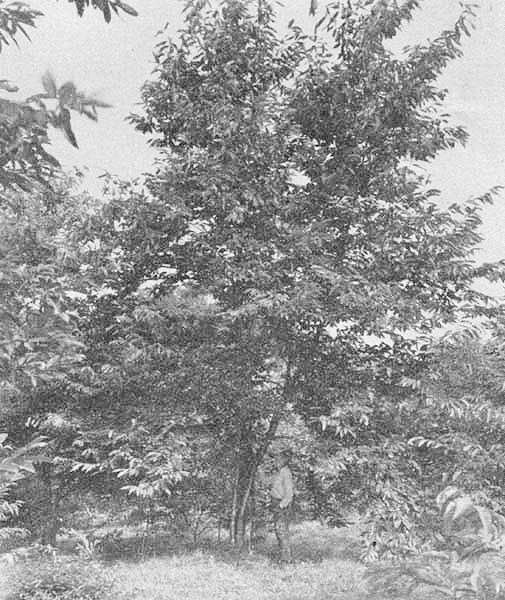
Fig. 1—Japanese-American hybrid chestnut (Hammond 86-31) 34½ feet in height, 16 years old. This is the same tree three years later as that shown in figures 1 and 2, in 35th Ann. Rept. of Northern Nut Growers Assoc. for 1944. Note healthy development, as shown by foliage and long yearly growth. Hamden, Conn. Photo. Sept. 13, 1947 by Louis Buhle.
Chinese Chestnuts. I am enthusiastic about Chinese chestnuts as a nut substitute for our old native chestnuts. The Chinese are quite blight resistant. They are attacked by the blight fungus—at least most individuals suffer at some time in their lives, and yet the fungus doesn't thrive and the trees are able to overcome its attacks, in many cases forming a healing wound callus around the lesions; in others the lesion becomes simply a granular mass in which the fungus appears to be living only in the outer bark. Cultivation, fertilization, and judicious pruning certainly help these trees to withstand these fungus attacks. We harvested a bumper crop last year and this from trees given us in 1929 by the Division of Forest Pathology, U.S.D.A.
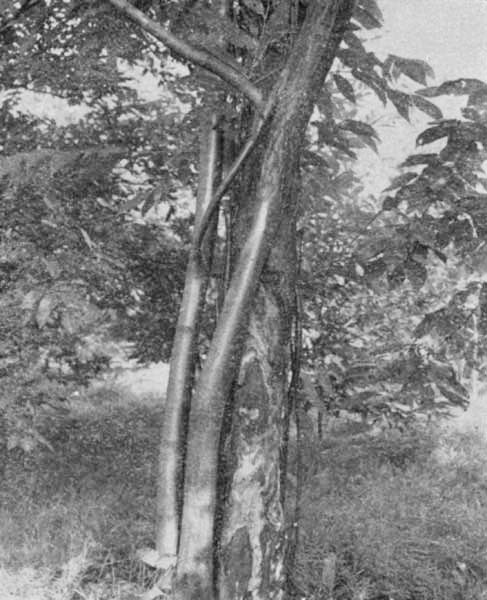
Fig. 2.—Close-up of lower part of tree in fig. 1, showing inarched basal shoots which at the beginning were as slender as the leafless shoot now showing on right side, below, coming from base of trunk. Note exposed dead part of trunk showing old canker disease. Photo Sept. 13, 1947, by Louis Buhle.
Public Interest in the Problem. Last fall, September 1946, in an article in the Yankee Magazine, I asked for nuts and pollen of the American chestnut. As a result the following persons from many different parts of the country sent in nuts: Mr. Henry Hartung, Methuen, Mass.; Mrs. Marie Garlichs, Brooklyn, from Lake Minnewaska, N. Y.; Mr. Charles Ericson, Brooklyn, nuts from Staten Island, N. Y.; Mrs. Jay B. Nash, N. Y. City, from Lake Sebago, Sloatsburg, N. Y.; Mr. H. W. Donnelly, Tacoma, Wash.; Mr. George M. Hindmarsh, Kent County, R. I.; Mrs. Steiner, Niota, Tenn.; Miss Marjorie Bacon, New Haven, Conn. from Litchfield, Conn. through Dr. Edgar Heermance; Mr. Harold E. Willmott, Bethel, Conn.; Mr. W. F. Jacobs, Tallahassee, Fla. (Castanea crenata); Mr. P. P. Pirone, New Brunswick, N. J. (C. crenata); Mr. Morton F. Sweet, Seattle, Wash. (C. sativa), nuts, and scions in March '47; Mr. John I. Shafer, Sparta, Tenn. This lists shows not only the widespread interest in the subject but also that the chestnut sprouts are still bearing nuts. In some cases the nuts were "blind," i.e. sterile, containing no kernel or embryo. In order to develop a good nut there must be two chestnut trees within a reasonable distance of each other so that cross fertilization may take place. Isolated trees will usually not bear nuts. In other words, the chestnut is usually self sterile. We are still planting all nuts received, labeled with the name and address of the sender. The resulting trees are being set out in the Yale Forest in Tolland and Windham Counties, Conn. under the direction of Mr. Basil Plusnin, Forester in charge. Thus the possibility is being explored of the existence of blight resistant strains of the American chestnut. When nuts are sent they should be mailed within a few days after harvesting and wrapped in moist cotton, peat moss or something similar. Drying of the nut kills the embryo so that it will no longer germinate. Nuts should be mailed to me at Chestnut Plantations, Wallingford, Conn.
Pollen of the American chestnut is getting scarce. After scouring the vicinity of Hamden, Conn. this summer, we found a good supply at Bethany, Conn. from native shoots. The following persons also sent us American pollen, for which we are indeed grateful: Mr. George Gilmer, Charlottesville, Va.; Mrs. M. E. Garlichs, Lake Minnewaska, N. Y.; Mr. Alfred Szego, Pine Plains, N. Y.; Mr. Seward Pauley, Sumerco, W. Va.; and Mr. Charles W. Mann, Fennville, Mich. To ship the pollen it is necessary only to wrap small branches bearing the catkins in oiled paper and mail to me, preferably by air mail. The catkins should be ripe, i.e. shedding the pollen.
Acknowledgments. It is a pleasure to have this opportunity to express our appreciation of the cooperation of the above mentioned persons. The interest of these and many other persons and institutions is encouraging. During 1946 and 1947 this project has been sponsored by the Connecticut Geological and Natural History Survey, and we have as usual enjoyed the cordial cooperation of the Division of Forest Pathology, U.S.D.A. Dept. of Agriculture.
Beginning as of October 1, 1947, the work is also being sponsored by the Connecticut Agricultural Experiment Station, New Haven, Conn. On July 1 I retired from my position as Curator of Public Instructor at the Brooklyn Botanic Garden and shall now be able to devote my entire time to the chestnut work. My permanent address will be: Chestnut Plantations, Wallingford, Conn.
Chinese Chestnuts in the Chattahoochee Valley
G. S. JONES, Route 1, Box 140, Phenix City, Alabama
(Excerpts from letter to Secretary, Oct. 23, 1947.)
Growing trees is a work dear to my heart for I have been interested in it since childhood. Dr. J. Russell Smith's book on "Tree Crops" is one of the best I have ever read along the lines of growing trees to produce food for man and beast as well as producing many other useful products, and much of the work of your Association seems to be along the same line. I am sure we can live easier and better on this earth when we learn to use the trees in their proper place. Man often acts in a shortsighted way by depending largely on annual crops for the main source of food for himself and his animals and neglects the long lived trees which may not have to be planted but once in a lifetime and which, if given a little intelligent management, will improve instead of deplete his land and at the same time make a far more beautiful landscape.
I only have a few trees (maybe 200 or 250) in my nursery which I usually dispose of at the farm or use to set on my place. I have not attempted to grow many seedlings as I don't wish to get into this phase of work. It would take too much time from other work which I like to do. This fall I have sold over 600 pounds of nuts to various nurseries for planting so I would prefer that they grow and sell trees from my orchard. I gather planting nuts from the trees which show the best qualities, consistently, and sell the nuts from the other trees for eating purposes. The trees from which I sell eating nuts have some bad qualities such as some of the nuts being retained in burs, irregular or poor production, and nuts that seem to be too dry at ripening so I would not offer these for sale although the pollen from these trees does mix with the others causing some of the nuts to carry these bad features, a thing which will hardly be avoided in open-pollinated seedlings.
Your letter made me more proud of my orchard than ever when you made the statement that my last year's production of 1,722 pounds for 22 trees so young as mine may have set a record for production. [See 1946 NNGA Report, p. 128—Ed.] I had little idea how my trees compared with other orchards, for Mr. Gravatt had not told me anything about this. In fact I have never seen him nor did I take the trouble to write and ask this question. I knew my trees were producing much better than an orchard of the Soil Conservation Service at Auburn but I attributed that to the better type of soil (for chestnuts) in which my trees are set, and better air drainage. I had also heard about an orchard near Blue Springs above Columbus, Ga., which was not doing so well because the soil was maybe too heavy or damp. I can say one thing and that is that my Chinese chestnuts have surely surpassed my fondest hopes and dreams, for that small area has certainly made me lots of money and has given me much joy in tending it and watching it grow.
You asked me to give some information about my 1947 crop. This has not been quite as large as last year as I have harvested only a little over 1,554 pounds (I say a little over for it is hard to get all the nuts) of weighed nuts. This includes some that were beginning to spoil. I include these since it is sometimes due to my failure to gather promptly and I think can be fairly included in production records. I might state here in fairness to last year's report of a yield of 1,722 pounds of nuts that I recorded 1,557 as being sold which leaves a difference of 165 pounds, which were either discarded as spoiling or were unaccounted for. This gives me a loss of approximately 10% for last year.
Although my total production was lower than last year I had one tree (ML No. 2) which produced 150 pounds of weighed nuts and a few pounds more (maybe 2 or 3) which were not included. This tree has been a consistent heavy bearer for several years but I had not checked its yield separately before. Since it is so early it was easy to keep the nuts separate (as I was keeping these to sell for seed nuts). In about 2 weeks time it had produced about 130 pounds so I made a special effort to check the remainder since I was astonished at so large a yield. When most of the nuts had fallen I had the above figure, to my surprise.
The tree in size is not my largest but about average being 12½" in diameter 3' above the ground with a limb spread of 30' and a height of 24'. It has a very symmetrical shape with enough rigidity in the limbs to hold them off the ground so the tree does not appear very large.
I just had to laugh when I got a letter yesterday from Mr. Ralph D. Gardner, whom I had written previously about the yield of this tree and sent 2 pounds of nuts from it, asking me if the tree produced two crops in one year. He said Mr. James Hobson had told him that he gets two crops from his tree each year. Mr. Gardner had a good reason to ask this question since knowing about the Hobson chestnut, but I reckon he might have thought about what I would have thought under similar circumstances, i.e., surely a tree so young (13½ years from setting) couldn't produce that many nuts at one time, so must have two ripening periods to contain the fruit. I will have to say that all these were produced in one crop. Most of these ripened in just a little over two weeks. I might say that I do have one tree (ML No. 1) which has on a few occasions bloomed the second time and had burs which remained green until near frost but these did not amount to anything and I consider it undesirable. I have never seen No. 2 tree produce late blooms and burs.
I might tell a few things as to how I handle my nuts. As is well said by Mr. Reed in his 1946 article about chestnuts they should be gathered daily (although I sometimes don't carry this out). After weighing I dump the nuts in a tub of water. The nuts which are beginning to spoil will practically all float and the sound nuts will sink. This is where the largest percentage of my culls is eliminated. Some good nuts will float but very few if the nuts are gathered daily. I then put 20 to 25 pounds of nuts in a coarse mesh burlap bag. I use chicken scratch feed bags mostly as these are a nice size, and ties a string near the top of the bag. Then I place these on a lath frame which is about 12" above the ground under a large pecan tree which furnishes shade about ¾ of the day. I arrange the nuts in the bag so it will be flat, which does not allow more than 2 or 3 nuts to be on top of each other.
On days of moderate temperature I wet these bags thoroughly with water once a day but on very hot or windy days I often wet them twice. This keeps the nuts moist most of the time and lowers the temperature considerably from the evaporation. In this way I can keep the nuts days and days and even weeks with very little change except a slight drying. If any spoiled nuts were missed by the water these too will show up in about 10 days with specks of white mold and can be eliminated. The other nuts seem to be as good as the day they were gathered. I only use this to keep them temperarily (as it is some trouble to wet them) and mostly for the eating nuts until I can take them to market or put them on cold storage (30° to 35°F.) If I attempt to hold seed nuts about a week or more I pack in damp sphagnum in crates and keep these under the shade tree with excellent results. This year I used green sphagnum with all its water and the nuts seemed to keep well in it. Some nuts have been in damp sphagnum for over 5 weeks now and are in excellent shape except for a few that spoiled at first (which I am quite sure were bad to begin with). If too much water is used some nuts will begin sprouting but it is surprising how much they can stand and show no tendency to sour.
I am of the opinion that the chestnuts in my section get ripe prematurely and that at a time when we often have our hottest and dryest weather. These nuts seem to need a period to continue their ripening under cool moist conditions which the wet sack treatment gives (or the damp sphagnum.) Even if this is not the case I have had splendid results with it whereas before I began using this method with lots of water I often became so discouraged that I thought I would have to abandon trying to put my chestnuts on the market. Now if I can get them gathered promptly I have little trouble holding them until I am ready to dispose of them.
I failed to tell you that the bad feature about my ML No. 2 tree which produced the 150 pounds of nuts is its early ripening period (the latter part of August and first part of September) which causes some of the nuts to be spoiled almost when they fall. A few hours of too hot sun seems to start the spoiling process. The tree has no other objectionable features except the nuts are only small to medium in size but nearly every one falls freely from the burs. [Nuts about 70 to the pound.—Ed.]
Some Results with Filbert Breeding at Geneva, N.Y.[6]
GEORGE L. SLATE New York (Geneva) Agricultural Experiment Station
This paper reports the results of attempts to improve filberts by hybridization at the Experiment Station at Geneva, N. Y. The filbert project was started at Geneva in the spring of 1925 when a collection of varieties from American sources was established. In later years additional varieties from European and other sources were added until about 120 were under test. As soon as the varieties had fruited for several years it became evident that many of them were inferior and not adapted to New York conditions. A few exhibited considerable merit and the range of characteristics in the different varieties indicated that it might be worth while to start a filbert breeding project with the object of combining the desirable characteristics of the better sorts.
It was decided first to cross Rush, a selected form of Corylus americana, with the best varieties of Corylus Avellana, Rush contributing the hardiness of the native hazel, possible resistance to filbert blight, and the hybrid vigor that sometimes results from the crossing of two species. The European filberts were expected to furnish large-sized nuts as well as dessert and cracking quality.
The first crosses were made in 1930 when two trees of the Rush variety growing on Dr. MacDaniels' place in Ithaca were pollinated with pollen of several varieties of Corylus Avellana that was brought from Geneva. Additional crosses were made at Ithaca in 1931 and 1933. In 1932 the pollinations were made at Geneva, using a Barcelona tree covered with a tightly woven cloth. No pollinations have been made since 1933.
In the spring of 1932, 535 seedlings were received from Willard G. Bixby, of Baldwin, Long Island, N. Y., which had resulted from crosses made by C. A. Reed of the United States Department of Agriculture, at Baldwin. Including these U.S.D.A. seedlings and those resulting from the breeding work at Geneva, 1,999 seedlings have fruited.
The nuts from these crosses were stratified in sand in a cold frame, dug up, and planted in the greenhouse in early March. After one transplanting they were moved to the nursery to grow for two years, when they were moved to the seedling orchard. The nuts from one year's crosses were planted directly in the nursery but germination was low due to drought.
The seedlings were spaced 10 x 5 feet in the orchard. This spacing was satisfactory if the trees came into bearing the fourth year, but if unfavorable weather eliminated the first or second crops the trees became too crowded to permit satisfactory fruiting. Usually, however, the trees fruited sufficiently to make it possible to evaluate them and remove the inferior trees so that the better seedlings would have enough room to remain for several additional crops.
During the first few years the orchard was clean cultivated until cover crops were sown in August. In later years the orchards were not cultivated but nitrogen fertilization was substituted. Satisfactory growth was maintained, but the grass and weeds made harvesting more difficult. No pruning was done except at planting time as the seedlings were all evaluated before pruning was needed. Suckers were removed around the young trees, but as they became older this was not done and some of the plants now have several stems.
Evaluating the Seedlings
The nuts were harvested in the fall after they had dropped, or, with the later maturing seedlings and those which tended to cling to the tree, they were harvested by picking or shaking them from the tree. As soon as practicable the nuts were husked and the crop of each tree weighed and recorded. Samples of nuts of every seedling fruiting were placed on paper plates, each population being by itself, and eight or ten nuts of each sample were cracked and left on the plate. The seedlings were then divided into three classes, those that were obviously good, those that were poor, and an intermediate class that received further attention. The poor seedlings were marked for discard and if so marked for two or three years they were pulled out.
The good seedlings were then examined more carefully and sorted into three groups, as follows:
1. Those that were outstanding in both nut and tree characters.
2. Those that were good enough to propagate for a second test, but not equal to the best.
3. Seedlings good enough to keep for further observation. These were usually good in one or more characteristics but deficient or doubtful in one important feature. If upon further testing these third group plants proved to be outstandingly productive or hardy they were given a higher rating.
In examining the nuts, emphasis was placed on size and color of the nut, the large, bright brown nuts being considered more desirable than the smaller, duller colored, pubescent nuts. The amount of space between the shell and the kernel was important. If the kernel fitted tightly it was easily broken or chipped in cracking the nut. Thickness of shell was of minor importance as only a few were thick enough to make cracking difficult.
The kernel characters were of most importance since the kernel is the reason for producing the nut. The kernel must be plump, smooth, light brown in color, and free of the superfluous pellicle, or fibrous material that is characteristic of the Barcelona kernels. Generally, seedlings with Rush as one parent had very little of this superfluous fibrous material and the best of them were much superior to Barcelona in appearance and dessert quality. Flavor received less consideration since most of the seedlings were reasonably good in that respect.
Given a good kernel, and there were many of them, it became necessary to rely upon other characteristics to eliminate the less desirable of these seedlings. It was here that the records of yields and catkin hardiness were valuable. After several years it became evident that certain seedlings were consistently high yielding while others were low yielding. Hardiness of catkin also varied greatly and rather consistently from year to year. Weather conditions influenced catkin killing greatly. Catkin hardiness is important since the pollen is necessary for nut production and must be present in abundance as its movement in the orchard is subject to the vagaries of the wind, and only a small percentage of that in the air ever comes in contact with the stigmas of the other varieties.
It is the purpose of this paper to indicate the value, insofar as it may be estimated from the available data, of the different varietal crosses in obtaining desirable filbert hybrids. Table 1 contains a list of crosses made, the number of seedlings raised, and the percentage of these which were of sufficient merit to be retained for further study. The percentage of seedlings propagated indicates even more definitely which crosses are of the greatest value in producing superior seedlings as only the outstanding seedlings were propagated for a second test. Selections included in Table 1 are there by virtue of their all-around merit.
Crosses between Rush and Littlepage and Rush and Winkler produced nothing of value. The populations were small, but other equally small populations from other crosses produced seedlings of value. The inter-crossing of selections of Corylus americana does not appear to be a promising line of attack in filbert breeding where hybrids with C. Avellana will thrive.
Rush and Barcelona were each used as seed parents in crosses with the same eight varieties. In the crosses involving Rush 1,232 seedlings were produced and of these 39, or 3.2%, were good enough to propagate. Of the 306 seedlings raised from the same varieties combined with Barcelona only 4, or 1.3% were worth propagating. None of these Barcelona seedlings are among the best. Under the conditions of the experiment it would seem that Rush is much superior to Barcelona as a parent in crosses with varieties of Corylus Avellana.
The cross between Kentish Cob and Cosford failed to produce any seedlings of outstanding merit.
In considering the productiveness and hardiness of the catkins of the seedlings resulting from the different crosses the data have been assembled in Tables 2 to 5, each table containing the summarized records for different plantings. These plantings were started at different times and the records are not directly comparable as they are for different years and varying lengths of time. In Table 1 the total number of seedlings is given, but in Table 2 to 5 only the data for the selections are used. Records for the selections are available for several years, whereas the inferior seedlings were discarded and limited data only are available. Furthermore, the filbert breeder is interested primarily in the worthwhile material that may be taken from populations of known parentage.
Assuming that we have a fairly good nut productiveness is the most important characteristic in a filbert. If the plant is productive it must of necessity be reasonably vigorous and hardy. For that reason much emphasis has been placed on productiveness in the final evaluation of the selections.
The selections in Table 2 are from the U.S.D.A. Bixby plants which were the first to fruit at Geneva. Considerable variation in productiveness is evident in the different populations. Rush x Kentish Cob and Rush x White Aveline selections were only about half as productive on the average as Rush x Barcelona, Bollwiller, Red Lambert, and Daviana. Rush x Italian Red also failed to produce high-yielding selections. In a later planting in the same orchard, as shown in Table 3, the Rush x Kentish Cob selections performed no better, the Rush x Red Lambert selections outyielding them by a substantial margin. The Barcelona x Italian Red selections were very low yielding.
In orchard 22, as shown in Table 4, where Rush and Barcelona are crossed with the same varieties, the resulting selections from the Rush crosses are about one third more productive if mean yields are considered, or one-half more productive if only highest yielding selections are considered than with the Barcelona crosses. Cosford has been outstanding in transmitting productiveness in crosses with Rush, Italian Red, and Nottingham. Rush x Kentish Cob selections in this orchard as in the other planting, were only about one half as productive on the average. In the crosses with Barcelona the combination with Medium Long, Red Lambert, and Italian Red were considerably more productive than crosses with Purple Aveline, Halle, Daviana, and Bollwiller.
The Kentish Cob x Cosford cross was less productive than most of the other combinations made. Kentish Cob definitely appears to transmit unproductiveness when crossed with Rush, Barcelona, and Cosford.
In orchard 8 as shown in Table 5, the trees soon became very crowded as the discards were not removed and the yield records were less reliable than in the other plantings.
Winterkilling of catkins were recorded on the selections for several years. In early April the percentage of winter-killed catkins was recorded by estimate. Tables 2 to 5 contain the mean of these estimates and a considerable variation in catkin hardiness in the different populations is evident. Red Lambert, which had the hardiest catkins of any variety of C. Avellana tried at Geneva, produced a higher proportion of catkin-hardy seedlings than any other variety. Cosford was fairly good in this respect and in orchard 16 Bollwiller, Italian Red, and Barcelona when crossed with Rush produced selections with moderately hardy catkins.
Winter injury of catkins was nearly always very high in crosses between varieties of Corylus Avellana.
Of the 1,970 seedlings included in Table 1, 340 or 17%, were retained for further observation and of these, 52, or 2.6%, were considered good enough to propagate for a more extensive test. Of these 52 a few thus far have been outstanding when compared with the others. Possibly the best and most productive selection is No. 1265, Rush x Purple Aveline, that is the heaviest yielding of all and the nuts are also among the best, being of medium size, plump, and free from fiber. This seedling is far superior to any others from the same cross. Nos. 1408 and 1467, both selected from a Rush x Cosford population, are close seconds to No. 1265. In the Rush x Cosford population are several others nearly as good, the general level of merit in this combination being fairly high. Farther down the list, but still among the best, are No. 110 Rush x Kentish Cob, and No. 157, Rush x Barcelona. Filbert breeders working under similar conditions would probably find it worthwhile to make these crosses and also to produce more seedlings from Rush x Red Lambert than were raised at Geneva.
No crosses have been made at Geneva in recent years, but all of the nuts from the selections, sometimes several hundred pounds a year, have been planted by the Soil Conservation Service and the resulting seedlings planted in various parts of the country. Undoubtedly, if these could be examined when in fruit, some worthwhile selections could be made. Those in New York State will probably be worked over during the next few years.
Table 1. Results from filbert crosses.
| Cross | Number of Seedlings Fruited | Number Retained | Percentage Retained | Number Propagated | Percentage Propagated |
|---|---|---|---|---|---|
| Rush x Kentish Cob (Du Chilly | 430 | 63 | 14 | 11 | 2 |
| Rush x Cosford | 447 | 52 | 12 | 11 | 2 |
| Rush x Bollwiller | 165 | 18 | 11 | 6 | 3 |
| Rush x Italian Red | 118 | 17 | 16 | 2 | 1 |
| Rush x Red Lambert | 36 | 10 | 28 | 6 | 16 |
| Rush x Daviana | 13 | 2 | 15 | 2 | 15 |
| Rush x Purple Aveline | 12 | 3 | 25 | 1 | 8 |
| Rush x White Lambert | 11 | 0 | 0 | 0 | 0 |
| Rush x Barcelona | 119 | 20 | 16 | 3 | 2 |
| Rush x White Aveline | 54 | 10 | 18 | 3 | 5 |
| Rush x Imperial deTrebizond | 24 | 5 | 21 | 1 | 4 |
| Rush x Nottingham | 23 | 7 | 30 | 2 | 8 |
| Rush x Brixnut | 8 | 2 | 25 | 0 | 0 |
| Rush x Littlepage | 12 | 0 | 0 | 0 | 0 |
| Rush x Winkler | 6 | 0 | 0 | 0 | 0 |
| Barcelona x Kentish Cob (Du Chilly) | 42 | 21 | 50 | 3 | 7 |
| Barcelona x Cosford | 57 | 27 | 48 | 1 | 2 |
| Barcelona x Bollwiller | 11 | 2 | 18 | 0 | 0 |
| Barcelona x Italian Red | 66 | 9 | 13 | 0 | 0 |
| Barcelona x Red Lambert | 41 | 12 | 29 | 0 | 0 |
| Barcelona x Daviana | 21 | 5 | 24 | 0 | 0 |
| Barcelona x Purple Aveline | 25 | 8 | 32 | 0 | 0 |
| Barcelona x White Lambert | 43 | 1 | 2 | 0 | 0 |
| Barcelona x Medium Long | 45 | 16 | 35 | 0 | 0 |
| Barcelona x Early Globe | 78 | 0 | 0 | 0 | 0 |
| Barcelona x Halle | 12 | 6 | 50 | 0 | 0 |
| Barcelona x Red Aveline | 9 | 1 | 11 | 0 | 0 |
| Kentish Cob (Du Chilly) x Cosford | 35 | 22 | 63 | 0 | 0 |
| Total | 1970 | 340 | 17 | 52 | 2.6 |
Table 2. Yields and winterkilling of filbert catkins, Orchard 16, 1935 1937, 1938 and 1939. Yields are 4 year total. Catkin injury is 5 year mean
| Number of Selections | Mean Yield per Selection in Ounces | Highest Yield per Selection in Ounces | Mean Percentage Catkins Winter Killed per Selection | Lowest Percentage Catkins Winter Killed | ||
|---|---|---|---|---|---|---|
| Cross | ||||||
| Rush x Bollwiller | 18 | 81 | 143 | 21 | 4 | |
| Bush x Kentish Cob (Du Chilly) 12 | 38 | 117 | 36 | 3 | ||
| Rush x White Aveline | 9 | 44 | 73 | 42 | 0 | |
| Rush x Barcelona | 6 | 94 | 147 | 26 | 8 | |
| Rush x Imperial de Trebizond | 5 | 81 | 100 | 28 | 10 | |
| Rush x Italian Red | 3 | 79 | 80 | 15 | 3 | |
| Rush x Red Lambert | 3 | 88 | 116 | 7 | 3 | |
| Rush x Daviana | 2 | 82 | 110 | 33 | 26 | |
| Rush x Purple Maxima | 1 | 37 | 37 | 17 | 17 | |
Table 3. Yields and winter injury of filbert catkins, Orchard 16, 1937-41 inclusive.
| No. of Selections | Mean Yield per Selection in Ounces | Highest Yield per Selection in Ounces | Mean Percentage Catkins Winter Killed per Selection | Lowest Percentage of Catkins Winter Killed | ||
|---|---|---|---|---|---|---|
| Cross | ||||||
| Rush x Kentish Cob (Du Chilly) | 26 | 38 | 102 | 68 | 5 | |
| Rush x Barcelona | 14 | 52 | 89 | 90 | 38 | |
| Rush x Red Lambert | 5 | 67 | 117 | 12 | 5 | |
| Barcelona x Italian Red | 3 | 18 | 20 | 83 | 73 | |
Table 4. Filbert selections. Orchard 22. Yields 1939, 1940, 1941, 1942, 1944, 1945 and 1946. Catkin injury records 1939-42, inclusive.
| No. of Selections | Mean Yield per Selection in Ounces | Highest Yield per Selection in Ounces | Mean Percentage Catkins Winter Killed per Selection | Lowest Percentage of Catkins Winter Killed | ||
|---|---|---|---|---|---|---|
| Cross | ||||||
| Rush x Cosford | 26 | 129 | 229 | 42 | 0 | |
| Rush x Kentish Cob (Du Chilly) | 25 | 68 | 185 | 70 | 13 | |
| Rush x Nottingham | 7 | 96 | 180 | 31 | 14 | |
| Rush x Italian Red | 3 | 114 | 181 | 45 | 30 | |
| Rush x Purple Aveline | 3 | 114 | 240 | 42 | 25 | |
| Rush x Red Lambert | 2 | 90 | 127 | 21 | 8 | |
| Rush x Brixnut | 2 | 49 | 51 | 62 | 58 | |
| Barcelona x Cosford | 27 | 90 | 138 | 62 | 32 | |
| Barcelona x Kentish Cob (Du Chilly) | 21 | 69 | 126 | 69 | 25 | |
| Barcelona x Medium Long | 16 | 93 | 257 | 83 | 71 | |
| Barcelona x Red Lambert | 12 | 83 | 147 | 52 | 13 | |
| Barcelona x Purple Aveline | 8 | 50 | 73 | 78 | 55 | |
| Barcelona x Italian Red | 6 | 84 | 133 | 90 | 81 | |
| Barcelona x Halle | 6 | 52 | 79 | 52 | 23 | |
| Barcelona x Daviana | 5 | 53 | 75 | 67 | 59 | |
| Barcelona x Bollwiller | 2 | 66 | 94 | 62 | 58 | |
| Barcelona x Red Aveline | 1 | 91 | 91 | 56 | 56 | |
| Barcelona x White Lambert | 1 | 103 | 103 | 5 | 5 | |
| Kentish Cob (Du Chilly) x Cosford | 22 | 62 | 151 | 64 | 33 | |
Table 5. Filbert selections. Orchard 8. Yields 1940, 1941, 1942 and 1944. Catkin injury records 1940, 1941 and 1942.
| No. of Selections | Mean Yield per Selection in Ounces | Highest Yield per Selection in Ounces | Mean Percentage Catkins Winter Killed per Selection | Lowest Percentage of Catkins Winter Killed | ||
|---|---|---|---|---|---|---|
| Cross | ||||||
| Rush x Cosford | 26 | 25 | 47 | 30 | 2 | |
| Rush x Italian Red | 11 | 25 | 39 | 27 | 0 | |
Discussion after Mr. Slate's paper—
MacDaniels: "Of the 1999 seedlings tested at Geneva, 52 are being carried on for further observations. Prof. Slate is doing a fine work."
J. R. Smith: "I want to express my appreciation of the work Prof. Slate is doing. To care for 1999 seedlings and keep the performance records is a big job and just the kind of thing on which progress depends."
Nut News from Wisconsin
CARL WESCHCKE
This year at River Falls, Wisconsin, which is only 35 miles southeast of St. Paul, Minnesota, the season started off with much rain and a delayed cold spring. All the grafting had to be postponed from two to four weeks later than normal. The stored scion wood suffered some because of this long storage period, and some of it was quite dry when taken out. This was particularly true of the Weschcke butternut and these scions looked so dry that I was tempted to throw them all away, but instead I gave them to two young horticulture students to practice with. None of them grew, however, so we had a 100% failure on butternut grafting. About a dozen years ago I had much success grafting butternut on black walnuts and was unimpressed, therefore I did not make any notes as to the process I used. This was a mistake for apparently I have lost the art. The last five years has probably produced only about five or six plants successfully grafted on black walnut. Hickories respond much better and I usually get about 50% successful grafts on my native butternut stocks.
Although the insect pests, such as the butternut curculio, were delayed in their attacks, they eventually caught up and destroyed most of the big butternut crop and did their usual damage to heartnut and Persian walnut growth. I noticed in the American Fruit Grower that plum curculio was controlled in the peach orchards through the use of hexaethyl tetraphosphate. If this chemical poison controls plum curculio, it ought to control any of the curculio family, such as the hazel curculio, chestnut curculio and butternut curculio. The butternut and hazel curculio appear to me to be the same insect. I am not troubled with the chestnut curculio yet, but if this chemical gives control over the curculio insect family we will certainly be able to raise large crops of all of the nuts mentioned.
Quite a few of my grafted test trees, both in the forest and in the orchard, which in some cases were grafted on bitternut hickory stocks fifteen years ago, are beginning to bear. These varieties are the Woods, Fox, Taylor, Platman and Davis. Others which have borne a few times previously also have good crops set. These are Bridgewater, Glover, Beaver, Kirtland, Deveaux and Fairbanks. The trees setting the largest crops of hickory nuts are the Weschcke, and they are the only ones that I can really count on maturing early enough to escape our usual early fall frosts.
I derive great pleasure in observing new seedling plants of filberts, hazels and their hybrids coming into bearing for the first time this year. There are about two hundred of these new varieties. Of course most of them will be worthless commercially. The ideal hybrid hazilbert has not yet appeared, but when it does we will propagate it for sale as rapidly as possible.
At this date, August 20, we have suffered from an extremely dry August and will apparently lose many trees that we cannot reach by irrigation or some other means of watering.
We have been busy at the farm and nursery erecting a small pilot plant for grinding filbert butter which we expect to be able to put on the market between October 15 and November 1.
There is about a one-fourth crop of black walnuts in my orchard trees, with the Thomas leading. Many of the Ohio trees are barren. Usually the Ohio bears freely.
It is my observation here that the wild hazels and some of their hybrids will drop their crop of nuts when it becomes too dry. This probably is an excellent feature from the standpoint of the plant as it no doubt saves the plant from being killed by drouth.
There is no doubt in my mind but that the hazel-filbert hybrids (hazilberts) will make a large agricultural crop in the corn belt. When these crops are shelled in local plants and ground into butter the industry will fall into much the same category as country creameries. However, we have not reached the point where we have the right commercial plants for this purpose and for the time being will have to use the Pacific Coast filberts until such large crops of the ideal hybrids appear.
Home Preparation of Filbert Butter and Other Products
MRS. JEANNE M. ALTMAN, Bellingham, Washington
Filberts may be prepared in different ways at home to make a delicious food. To make filbert butter first shell a roasting pan two-thirds full of kernels and put it in a 325° oven. Stir the kernels thoroughly and often to get an even tan. Cut a few in half to determine when they are brown enough. Cook about thirty minutes. Do not leave in oven any longer than necessary because the kernels begin to brown rapidly upon further cooking. Cool and stir when not too hot. Most of the brown pellicle can be removed by rubbing kernels between one's hands. Run the kernels through a food chopper or meat grinder to make a Crunchy butter. To make a more delicious product, however, first run the kernels through a coarse knife, salt them and then run through a fine knife. This results in a butter with enough oil of its own to make a delicious dish. It takes lots of nuts to make much filbert butter.
In preparing salted filberts in quantity I cook them in a strainer in a kettle of deep fat. Check the temperature with a thermometer and do not let them get too hot. Cool them quickly by putting them into a cold dish and stirring. When salting the whole kernels put only enough fat with them to coat the pellicle. After they are sufficiently brown take them out and salt them as they are cooling. Stir just enough to coat the kernels with salt. Eat pellicle and all; it holds the salt. Stirring too much tends to remove the salt.
You can treat a pound of nuts at a time in a heavy iron skillet on top of the stove stirring constantly. When we follow that practice we eat them salted just as they were instead of grinding them. I think they are better than salted peanuts.
I sent a recipe to one of our west coast papers and they added a note to drain them on a paper towel. That is wasteful and unnecessary. A Bellingham dentist put whole nuts into his false-teeth baking oven in the evening. I do not know what temperature was maintained but it must have been low because he left the nuts there all night and the next morning he found them all roasted and ready to eat.
Filberts, even the green ones just as they come from the tree, may be boiled and then salted and buttered. They may be used to advantage in many cooking and baking recipes.
Notes from Central New York
S. H. GRAHAM, Ithaca, N. Y.
This summer has been a difficult one for black walnuts. A late spring delayed starting and three freezes during the week beginning Sept. 22 prematurely checked development so that poor filling seems to be the rule. The Persian walnuts again demonstrated their ability to ripen their nuts in a short season.
Some of our Persian walnut trees are growing in the partial shade of larger black walnut trees. We prefer to keep these larger trees as they may be valuable stocks to be grafted to the superior varieties that one is always hoping will appear later on. This condition gives a good opportunity to observe the effect of shade. There seems to be no doubt that even light shade is detrimental in our latitude to the Persian walnut and results not only in more spindling and unsymmetrical growth but also interferes with proper ripening of the wood making it more subject to winter injury.
One difficulty with the Persian walnuts in the East is premature falling of the nuts. The female flowers on the young Persian trees that we have seen are usually more numerous than with black walnuts of the same size and age, but even hand pollinating often fails to give a good set of nuts. Last spring we took pollen from eight of our Persian trees to the pomology department of our State College of Agriculture for germinating. The best sample showed 45% viable pollen; the next best 15% and the rest from O to 5%. This had been collected and stored for several weeks according to the methods given by Dr. Cox in the annual report for 1943, page 58. It is possible that this lack of viability may be due to some soil deficiency such as insufficient lime or boron. Prof. Schuster of the Oregon station writes that they find that Persian walnuts readily accept good Persian pollen but not black walnut or butternut pollen. If the viability of the pollen falls below 50% they consider it unsatisfactory. On some of the Oregon soils an application of boron in the form of ordinary borax under the trees in the spring has greatly helped in getting a crop of nuts. This should be well worth trying in the eastern states.
The filbert crop this year is better than usual. Out of over a thousand crosses between Rush and Winkler with European and Pacific Coast varieties, in our estimation, only one has proven worthy of propagation considering size, flavor, abundance of bearing and resistance to filbert blight. Some growers think lightly of blight but our experience in fighting it through the years in cutting out cankered wood has convinced us of the futility of this means of control in infested areas. Control measures may apparently succeed for a time but when conditions of moisture, heat and air movement are just right it can spread like wildfire. Therefore, to us, resistance to this disease (Cryptosporella anomala) seems of paramount importance. The prevalence of blight has been almost universal in the scattered plantings which we have visited in central New York, usually without the owner knowing why his trees were dying. All our European and Coast varieties, as well as most of the hybrids, take blight readily but there is an occasional hybrid that is clearly resistant. Bixby is one of these.
We have always used a knapsack sprayer equipped with a mist nozzle for our trees but this is inadequate as the trees grow taller. This summer a much more satisfactory nozzle was found that may be quickly adjusted to throw a mist for low trees or a far reaching one for the taller trees. This is made by the D. B. Smith Co. of Utica, N. Y.
From time to time articles appear on insects injurious to nut trees. Frequently mentioned are the web worms and the walnut caterpillars. With us, the damage they do is as nothing compared to that caused by the curculios, the strawberry root worm beetles and the leaf hoppers. We are getting the upper hand of the curculios by the use of cryolite spray but the root-worm beetle problem is still unsolved. Until Rev. Crath wrote of leaf hopper damage (Annual Report 1938 p. 111) we had not regarded them as at all serious. Subsequent observation has convinced us that he was right and that they are often the cause of the blackening and dying of the tender young leaves of Persian walnuts and the curling up of older leaves. We were especially impressed during the Wooster, Ohio, field trip last year and, later on, in seeing how Mr. Sherman had overcome this trouble on the Mahoning Co. farm simply by adding DDT to his spray mixture.
In closing, we would like to call the attention of new members to the wealth of information that is to be found in the old Association annual reports.
Experience with the Crath Carpathian Walnuts
GILBERT L. SMITH, Wassaic, New York
In the spring of 1935 we purchased from the Wisconsin Horticultural Society two pounds of the nuts which Rev. Paul Crath had imported from Poland. We planted these nuts in the nursery row. Sixty-two seedlings resulted. We assigned a number of each of these seedlings and transplanted them when they were two years old. Here we made our first mistake. We selected what proved to be a very poor site for them, adjacent to and nearly surrounded by woodland, in which were a goodly supply of butternut curculios which we have found to be by far the worst insect enemy of the Persian walnut. It attacks the terminal growth doing some damage by feeding but principally by laying eggs in the terminals and the fleshy base of the leaf stems. From these eggs grub-like larvae hatch which bore into the terminal and the leaf bases, greatly dwarfing the terminal growth. We have found as many as six larvae in a single terminal. Of course they also like to lay their eggs in the young nuts which then drop from the tree in mid-summer.
In the spring of 1937 we started to graft from these seedlings on black walnut stocks, giving each the same number as that of the seedling from which the wood was taken. It is too bad that we did not start this work sooner as we lost a few of the seedlings, largely through the ravages of the curculio, but possibly some of them were just not rugged enough to stand our climate. We still have 49 of these varieties living, either as grafts or the original trees. To this collection we have added a few varieties, securing wood from seedlings being grown by others. We have had living grafts of some of the named Crath varieties which we suppose developed from some of the wood imported from Poland by Rev. Crath. All of these have failed with us except one, Carpathian D. Apparently they were not hardy enough for our climate.
So far we have had only one severe test of our Crath seedlings, as to hardiness. This was on February 16th, 1943, when the temperature at Mr. Benton's farm was thirty-four degrees below zero. This was not official but was registered by two thermometers which Mr. Benton knew to be very accurate. Many of our Crath seedlings showed no injury at all on this occasion while others showed varying degrees of injury. Our grafts of Broadview were damaged quite severely, Carpathian D to just about the same extent. One other named Crath variety, Crath No. 1, was killed outright. Only one of our seedling varieties showed as severe injury as did Broadview. This was S 12. This tree has now fully recovered but we will not grow any trees from it except for more southern latitudes and then only if it shows exceptional merit when it begins to bear. Therefore, according to our experience so far, there is quite definite evidence that these Crath seedlings are hardier than Broadview. McDermid was killed outright.
We have found that practically all Persian walnut trees, when young, will bear pistillate blossoms for several years before they bear staminate blossoms (catkins). This fact has delayed us in securing nuts from these seedling varieties and has compelled us to resort to hand pollination. However, they are now beginning to produce both kinds of blossoms.
The first one to bear was in 1944, when one tree bore twelve nuts which had resulted from hand pollination with pollen sent us by Mr. Reed. This variety appears to be the most promising one that has borne so far. We have named it Littlepage and have had a booklet printed which describes it fully. We will be glad to mail a copy to anyone who wishes. We have now found a good pollinizer for Littlepage, our No. S22 seedling. This variety produces pollen at just the right time, some of which I used this spring to hand pollenize the Littlepage tree. A fine crop of nuts is now on this tree as the result of this pollination.
Last year (1946) we had a few nuts from each of five other seedling varieties. While we did not consider any of them equal to Littlepage, they were all worth growing and compare quite favorably with English walnuts as found in our markets. This year we have nuts on each of eleven varieties, five of them and the same ones that bore last year and six new ones. Now that these seedlings are beginning to bear we are able to cull out any that prove to be very inferior. As our facilities are far too limited to thoroughly test the promising varieties, we have started to propagate them and offer them in many parts of the country and subject them to many different conditions. Thus it should be only a matter of time until the truly worthy varieties will prove themselves. If we were wealthy we could propagate them and distribute them free of charge but I doubt if it would prove as satisfactory as it is to charge for them, as it seems to be a trait of human nature to take better care of that which costs us something. We will not name these new varieties at present but will put them out under their test numbers. Later the ones that prove best can be named.
To facilitate the distribution of these new varieties we are getting out a folder showing natural size pictures of the nuts of the six varieties which were produced last year, with a brief description of each. I am very sorry that I was unable to get these folders from the printer before coming to this convention. However we will have them very soon and will be glad to mail a copy to anyone who requests it.
As stated before we have found that the butternut curculio is a very bad pest with the Persian walnuts, also heartnuts and butternuts. It does not injure the black walnut at all. There are also several other insects which feed on the Persian walnut, most of these chewing insects that simply injure the foliage more or less severely. Last winter I was advised by Dr. Dean of our experiment station staff, to try benzene hexachloride (hexachlorocyclohexane) for control of the curculio. He stated that in California they have found out that the Persian walnut is quite susceptible to arsenical injury when a spray containing arsenate of lead is used on it. Also tests so far indicate that D.D.T. is not very effective against the apple and plum curculio, therefore not likely to be effective against the butternut curculio. So last spring we secured a supply of benzene hexachloride. Just as we were about to spray the trees I discovered a swarm of orange colored insects with black wing covers, feeding on them. So I checked the compatibility chart in the February issue of the American Fruit Grower and found that benzene hexachloride and D.D.T. were compatible when used together in the spray mixture. I thought it would be well to use a double barreled dose. So we made up a spray of four pounds of benzene hexachloride, four pounds of D.D.T., 50% wettable powder, and 6 pounds of wettable sulfur to 100 gallons of water. This first spray showed a slight burning of the leaves, which I suspected was due to the sulfur. We omitted sulfur from the later sprays and did not note any more burning. We put on three sprays at about two week intervals and a fourth spray about the middle of July. The result of these sprays appears to be excellent. I have found only one nut showing any insect injury and this one was only slightly injured, whereas last summer we lost a considerable percentage of the nuts from curculio injury. A day or two after applying the first spray, I wanted to secure a specimen of the orange-colored insects with black wing covers, but I could not find a single specimen.
We did not apply our first spray quite soon enough and curculio larvae had already invaded a few of the terminals. The first spray should be applied about as soon as the leaf buds separate and quite likely should be followed by the second spray in about a week, as new growth is very rapid at this time and the scant foliage at the time of the first spray would hardly hold enough of the chemicals to give control for more than a few days.
Observations on Hardiness of the Carpathian Walnuts at Poughkeepsie, New York
STEPHEN BERNATH
In our section we have very good Persian walnut varieties of Carpathian and other European sources. I have planted some of all strains and varieties. My place faces northwest on a good elevation. My experience with trees there is that we have no winter injury. We can grow trees there that cannot be grown on some place which is situated low, and therefore does not have enough air circulation. Damage is done after heavy frosts when the sun comes out suddenly. That is what damages the trees—not the cold.
If you take trees and put them in a temperature of 35 to 40 degrees below zero and bring them out to thaw gradually no harm is done. Most people buy trees and plant them in low places; that is the error. We have planted trees where the wind is very heavy throughout the winter and in the spring I found that these trees stood up wonderfully well; whereas, we have European walnut trees with a trunk diameter of about 12 to 14 inches that in one year froze two to six feet—about three to four years growth. If you plant your trees on a fairly good elevation you can be assured of a good nut crop. In planting nut trees I do not know what kind of fertilizer you use, but I always use well decayed cow manure and put a little right around the root system. I never use fresh manure and never use poultry, sheep, or horse manure. They are bad for trees as they are very high in ammonia and this does damage to the trees.
Discussion after Graham, Smith, and Bernath Persian walnut papers.
Corsan: "Is using lime a good idea? I always use a lot of wood ashes."
Stoke: "Use ground agricultural limestone. Burned lime may cause injury."
J. R. Smith: "Barnyard manure is the best."
Stoke: "With the Carpathian walnuts there is no uniformity in winter injury. I have had the Crath variety kill back to two inch wood. Most others have never shown winter injury."
Corsan: "When is it practical to take mulch away?"
MacDaniels: "If you take mulch away too late you will get more injury than if you don't take it away at all."
Member: "Why does my young walnut tree not bear?"
Bernath: "English walnut trees may produce pistillate blooms for a number of years before they produce pollen so that if you have only one tree it may be due to lack of pollination."
Member: "With English walnut is more than one tree necessary for pollination? The male blossom appears a week or 10 days before the female."
Crane: "Persian walnuts should be used to pollinate Persian walnuts—do not depend on black walnuts. In growing Persian walnuts it is best to have trees of two or more varieties in a planting so as to provide cross pollination."
Stoke: "Persian walnuts may not pollinate black walnut, but black walnut has pollinated the Persian walnut in known instances."
MacDaniels: "Control or uncontrol of pollination is very complex."
Crane: "We find that we can not readily produce Persian x Eastern black hybrids under conditions of controlled pollination. We have found a number of natural hybrid trees but they bear very few nuts."
Nuts About Trees
R. E. HODGSON, Superintendent, Southeast Experiment Station, University of Minnesota.
When hiking with a Boy Scout troop, they often asked me, "What tree is that?" In summer I could usually tell an oak from a box elder but had never had much reason to go further into the subject until the boys exposed my ignorance. In self defense I began to hunt up the names and found it a most interesting hobby.
The University of Minnesota has a branch experiment station some 80 miles south of the Twin Cities and it is here that a few acres have been roped off as a testing site for whatever trees of interest we can persuade to grow. My job is with field crops and livestock but my golf, fishing, hunting and bridge are mostly played with a spade and pruning shears or wandering around in the brush somewhere looking for something new. Our soil is a heavy clay loam of Clarion type containing plenty of lime but often poorly drained. It is very rich and productive being at one time part of Minnesota's big woods. Native trees are basswood, oak, elm, ash, walnut and their associates.
My ignorance concerning trees is still profound and becomes more apparent as acquaintance matures, but it has been a lot of fun to start about 130 varieties of trees and shrubs and watch their development. The Latin names are mostly a mystery to me, but their habits, methods and rate of growth along with soil preferences and winter survival have furnished more entertainment for me than picking shot out of a dead bird or furrowing the turf on a putting green. It has been a real thrill to see cypress, sycamore and even a few yellow poplars, survive our rugged winters.
The project began with an attempt to collect native trees and expanded to make room for some exotics, just to see what would happen to them. Detours and by-paths included attempts to grow various conifers from seed and persuade cuttings to root. Somewhere along the line nut trees began to enter the picture and now these have an alcove all to themselves. Perhaps it started when a neighbor offered me $5.00 if I could tell whether a young sprout in his yard was butternut or walnut. He died before I found the answer which was probably common knowledge to most people. The color of the pith did not seem reliable, but at last a book pointed out the little moustache a butternut wears just above each leaf scar. It worked, and the thrill was equal to catching a 10 pound wall eye!
I was raised on the prairie part of southwestern Minnesota and it was a delightful surprise when I moved 140 miles east to find that one could gather almost any desired quantity of black walnuts from remnants of the old forest. After a few years these trips to the woods became less glamourous and the pickeruppers more critical. Many of the wild nuts were small and hard to crack. Perhaps a friend's Thomas tree in full bearing with its heavy crop of huge, tasty nuts inspired a wish to grow bigger and better producing trees near at home.
It looked easy to transplant vigorous, 6 foot black walnut whips which could be had for the digging. It took 10 years to learn that nuts properly planted would make larger trees in a decade than transplants. Digging 2 deep holes to move one tree seemed a waste of labor when one planted nut would better serve the purpose. Of course nut planting led to a contest of wits with the squirrels.
It was a funny sight to watch a helper carefully placing nuts at regular intervals in an open furrow and a big fox squirrel following 10 feet behind him, removing the prizes as fast as he could scamper up and down a nearby hollow oak. Our ideas concerning appropriate locations for walnut trees did not coincide with those of Mr. Bushytail. We learned that the simple way to plant walnuts in the woods was to pile a half a bushel here and there. The tree climbers took their toll, but did a good job of planting. Survival seemed better than when we placed individual nuts and "stepped them in."
The desire for bigger, better and more useful nuts led to the planting of a couple of acres to seed from various trees of known value. These will not come true of course but it is hoped that some day they may serve as material for a small nut breeding project in which an attempt will be made to combine some of the more desirable chromosomes into a single tree that retains the best of what we have in present selections, and adds a little more hardiness between growing seasons. Who can tell? We might find a tree that the walnut worms didn't like!
The squirrels didn't fancy our plans to grow trees in rows according to parentage, so they tried to improve our technique. We almost called in the F. B. I. to circumvent their machinations. Jamming an open tin can over the planted nut seemed to help. When the sprout came up we turned up the edges of the split can bottom just enough to let the tree through, but the sharp jagged edges seemed to discourage marauders. A lot of other methods were also tried.
From the Wisconsin Horticultural Society we obtained a pound of English or Persian walnuts in 1937. So far we have some 23 seedlings struggling to keep alive. They range in height from 18 inches to 7 feet and are definitely out of their range. Some years they grow 4 feet of new wood and some winters it all kills back. There seem to be differences in hardiness and—who can tell?—they might even bear a nut some day. Bark injury, which may be winter sun scald, has damaged some of the trees. One tree of the Broadview selection is alive after four years and may make a go of it.
Hickories grow wild in certain parts of Minnesota, but this doesn't happen to be one of those parts. They seem to do best where soil is acid in reaction and here we are amply supplied with lime. That may account for the slow growth of a grafted Hales hickory tree. It was 3 years old when set out in 1921. For the first 9 years it had just 2 leaves per year. Now approaching 30, the tree is 7 to 8 feet high and going up at the rate of 8 to 12 inches a year.
Nuts from Wisconsin, Michigan, and Minnesota wild hickories, have done better. At 8 years the trees are from 1 to 2 feet high, with a couple of Shakespeares, (geniuses) towering a foot above them. This may not be hickory country, but, by gum, they're growing! A couple of years ago, Dr. Brierley from the Central Station, Division of Horticulture, who has nut propagation as one of his minor projects, gave us 7 seedlings of shellbark hickory, (Carya laciniosa), from a tree planted many years ago by Peter Gideon of Wealthy apple fame. After 2 winters, these 7 seedlings are still with us and seem to grow faster than the shagbarks (ovata).
Other attempts to vary our diet (if we live long enough) are a few Chinese chestnut seedlings. A couple secured from the Nut Tree Nurseries, Downington, Pa., in 1940 are now 3 and 4 feet high and apparently in a good state of health. They are leisurely growing, which may be a good thing. Trees like the Manchurian walnut which grow 6 to 8 feet of new wood in a year, seem to freeze back and start over more frequently than the trees which poke along but harden their wood before cold weather. In 1946, a few more seedlings from D. C. Snyder, Center Point, Iowa, were set out and most of them have survived the first winter. Carl Weschcke reports that chestnuts do best for him at River Falls, Wisconsin, in sandy soil with an acid reaction. If I ever raise a chestnut, I'd like to send him one.
Fooling with nuts has led to another activity which has been pleasant though not very practical so far. Each spring, Dr. Brierley spends a couple of days with me trying to graft some of the named varieties to our available wild trees. We have raised nuts on some of the hickory scions grafted to the plentiful native bitternuts, but in general our grafts have failed. We have had good advice from many sources and have tried most everything but our successes have not been numerous enough to cause any inflation of the ego. We're inclined to think that the sudden wide variations of temperature which are common here in May, can be the controlling factor. We've made a few walnuts, hickories, and hicans grow, but still have too many zeroes for any complacency. This year may be our bonanza. Most of the grafts on some 40 trees are shooting buds. Perhaps it's the grafting tape we tried this spring. In 1948 we'll be able to write it all down in the book—and try again.
Nuts are not the only food crops growing on trees. We have read the glowing reports of sweet pods of honey locust grown on such varieties as Millwood and Calhoun, as told by John Hershey and J. Russell Smith. Our Millwoods all killed the second winter and this year we're trying Calhoun. Meanwhile, we're hunting for a hardy, northern grown sweet tree. Miss Jones asked nut growers to tell me what they had and several interesting replies and samples were received. The quality of the pods varied all the way from the sweet Millwood to our native honey locusts, most of which are so bitter and astringent that they remind us of a combination of green persimmons and red pepper. No sensible animal will touch them. Cions were received from a tree in Omaha, Nebraska, through the courtesy of F. J. Adams. These were grafted on local trees this spring and perhaps they will answer all of our needs.
Our attempts to grow better nuts in southern Minnesota have not caused even a ripple in the local economic situation, but it has been a lot of fun. Perhaps the greatest return so far is the interesting correspondence with like minded people in many localities. Amos Workman of Hurricane, Utah, sent seed of his best black and Persian walnuts, pecans and figs. The figs didn't even start (probably my ignorance), but we have trees coming from all the rest. J. Russell Smith has been most helpful with suggestions and the "Minnesota Horse Thief" as he calls me, has enjoyed his letters immensely. John Hershey has passed along some of his enthusiasm for trees and many others have contributed to the pleasure of a fascinating hobby.
It's fun to grow trees even though some of the unusual things provide only exercise and entertainment. Our persimmons grew from seed, were transplanted and came through the first winter! One pawpaw is still trying to get ahead of the winter set-backs, and a Macedonian white pine (said to produce edible nuts) is doing fine. Perhaps I'm the biggest nut of all, but I'm happy about it!
Report on Nut Trees at Massillon
RAYMOND E. SILVIS, Massillon, Ohio
I will first give an account of plantings observed recently in or near Massillon, and, secondly, a condensation of my own introduction to nut growing.
Louis Bromfield in his richly descriptive book "The Farm" writes, "On the way one passed the big orchard which was Jamie's pride, and beyond one came to the field where the big hickory stood. It was a memorable tree, famous in the countryside for bearing enormous nuts with shells so soft that the faintest tap of a rock or a hammer would lay open the bisque-colored kernels." He also writes a reference to the ingredients of candy making at Christmas time in which a good many recipes called for hickory nuts and walnuts.
In Massillon Mr. Alvin Schott, when he drove by the farm of Mr. Lester Hawk and read his sign, "Chinese Chestnut Trees for Sale," thought of the chestnuts he used to eat. Since he, like the rest of us, cannot go out along the road in the fall and pick up chestnuts as of old, he declared to plant some nut trees on city park land so that the younger generation could in a small measure recapture that which now is only a memory.
After making numerous talks and speeches to all the lodges, civic clubs and P. T. A.'s, he received donations and publicity to help him in his project. He enlisted the help of other civic nut-minded personnel to help him select the trees and locations for planting. Boy Scouts and school children dug some of the holes. When it rained (it seems to rain every time a shipment came in) Mr. Schott would call us away from our work and have us dig holes. We have planted in city parks: 13 Hawk chestnuts, 10 Thomas black walnuts, 8 hazel, 4 mulberries, 2 Broadview Persians, 2 Josephine persimmons, 3 pecan seedlings, 1 hican, 9 large seedling black walnuts and several hickories.
We have additional money for another spring planting. Thus Massillon has joined the list of cities that own trees that will produce something else besides leaves.
On August 17th Mr. Gerstenmaier and I drove to Ira, Ohio, to visit Mr. Cranz and take advantage of his invitation to inspect his nut planting. At this moment I believe that his invitation was made with the subtle purpose of bragging about his excellent crop of Thomas black walnuts and filberts. The trees were originally planted by squirrels and later grafted by Mr. Cranz. They grow at the bottom of a huge hill or escarpment 200 feet high at the top of which is his planting of 20 mollissima chestnuts. It's a long climb through his neatly scythed pathways on a hot day. Afterwards I felt like I needed the can which he usually carries.
Recently I found a young black walnut which I hope may be a good selection for further work. It is too early to make any predictions, but I can assure you that a careful check on the tree's performance will be interesting. Thin shell, good kernel cavity, etc.
Near Bolivar, Ohio, stands a young shagbark hickory which bears a nut about the size of a Pleas hican with a very smooth kernel cavity and a thin shell. Even though small this is another nut which will bear watching.
I believe the greatest interest in nut trees will develop when a definite program of controlled crossing is instituted.
When I became a member of this organization in 1939 I was managing almost 1,000 acres of farm land. My own 90 acre farm was being farmed up and down the hill because the fences were built that way. My plan was to change over to a contour operation. After reading "Nut Growing" and "Tree Crops" I decided to plant nut trees at 100' intervals along the edges of the contour strips. I had a twofold purpose, to produce more revenue and preserve the contour method of farming.
I ordered grafted nut trees from Jones Nurseries, Crath seedlings from Graham and 200 northern pecan nuts from Wilkinson. Homer Jacobs, really "sold me" on the Nut Growers Association and then sent me scions of the Wilcox hickory. I was successful in getting two to grow about 100' apart. Miss Jones sent me Pleas hican wood and one graft grew between the two Wilcox. All were grafted on shagbark stock, breast high using the late Mr. Fickes' method. The pecan nuts were stratified and given the usual nursery care and at three years of age were transplanted to the farm along with 200 seedling black walnuts and 100 chestnuts. These seedlings were to be used as stocks for grafting the newer and superior productive varieties. This was 1943. The farmer became dissatisfied with my soil conservation tendencies and moved away. The war developed in earnest and I matriculated at a defense plant. The farm just grew up. I was not dissatisfied. I was just tired. I couldn't find enough time to manage 1,000 acres of farm land 20 miles south; work at a defense plant 20 miles north and operate my insurance and real estate business. So I sold all the farms including mine with the nut trees.
Now it is 1947. It was only two years ago that I made a decision to relinquish the 90 acre farm. A short time ago I found all the grafted trees bearing fruit except the hickories and hican. The grafted Zimmerman, Stoke and Hobson chestnuts have died and most of the pecan, walnut and chestnut seedlings planted on the contour strips have succumbed to the mower, etc. I could find none of the grafted hickories purchased through the years except one Fairbanks. The present owners are enthusiastic over the early bearing chestnuts and are taking care of all the remaining survivor trees.
I have reached the conclusion that any farm in this section of the U. S. with enough hope to warrant contour farming is usually marginal land. This is land which barely pays the cost of working or using; land whereon the costs of labor, coordination and capital approximately equal the gross income. I believe that a planting of grafted nut trees on the edges of contour strips will increase the value of that farm and should have the attention of every county agent and farm owner.
I am no doubt the worst "grafter" in the business. When I get one out of 20 sets to grow I am startled, not so much with the statistical percentages but because a small stick of wood from Kentucky can make its home on the roots of an Ohio cousin. I believe that scion storage is important and I wish to report that the method which Dr. Shelton explained in the 1945 report is very satisfactory. The next best is John Gerstenmaier's apple storage cellar, which he and I have used ever since my interest in nut bearing trees brought us together.
It is still 1947. I'm still in the real estate business. I recently purchased 160 acres of land in an adjoining county and placed title in my son's name. He is six years old. I should be free of any inclination to sell this for fifteen years. Since there are no buildings I won't have a tenant problem. This spring I purchased and planted grafted hickories and grafted black walnuts and set them in supposedly favorable locations where I hope they will maintain themselves. In addition I planted about 200 Hawk seedling chestnuts spaced about 20 to 30 feet apart. These were planted in three different locations. One group was planted under the canopy of a locust grove, another on an exposed hilltop which faces the prevailing westerly winds. The third is on a broad hilltop field which does not have the best drainage since the top soil is clay underlaid with sandstone shale. All of these groups grow on land abandoned some years ago. The soil fertility is generally low. Volunteer native growth of cheery, ash, dogwood and hawthorn prevails.
If I can continue to plant for the next fifteen years I should have quite an orchard, or else my son will have a good hardwood forest. I hope that all of us here can meet there then.
Discussion after R. E. Silvis' paper.
Mr. MacDaniels: "It is a good idea to have nut trees established in the parks. In your home town there is usually a park in which nut trees can be used. Very often it just takes initiative to get these things started. Boy Scout organization is very good at starting projects like this. Chestnuts are more difficult to establish than other trees."
Dr. Gravatt: "Nut trees should not be grown along the curbs because people will gather the nuts that fall on the road. This is very dangerous where there is much traffic."
Stoke: "Walnuts are much more satisfactory as park trees than Chinese chestnuts. People are so prone to break off branches bearing immature chestnuts."
Dr. MacDaniels: "Wire guards are excellent to keep mice, rabbits, etc., away from your nut trees."
Planting of Nut Trees on Highways Undesirable
R. P. ALLAMAN, Harrisburg, Pa.
Having always opposed this practice when it was under discussion, I have been asked to prepare an article on the subject. This paper was prepared in collaboration with Mr. Wilbur H. Simonson, Senior Landscape Architect, U. S. Bureau of Public Roads, Washington, D. C.
Since the beginning of the roadside improvement demonstration program in 1933 the policy of the Public Roads Administration has never favored planting of the showy, garden type of fruit and nut trees on highway roadsides for several reasons:
1. Traffic Hazards—Dropping of fruits and nuts on pavements tends to make surface conditions slippery and dangerous to traffic.
2. Police Problems—Ripening of fruits and nuts tends to invite passing motorists to stop on side of highway pavements to gather the fruits, adding to traffic hazard. Also such trees tend to invite vandalism by boys together with clubbing the trees to get down the fruits with the possible results of not only injury and damage to the trees themselves, but throwing sticks, stones and clubs into the tree branches is likely to result in hitting or striking passing motorists and otherwise cause loss of control of vehicles by drivers, a very dangerous road condition especially because it is an unexpected situation to have clubs or fruit come down on the highway when driving through.
This all means more intensive policing of the highway by the responsible authorities with added costs in maintenance budgets.
3. Maintenance Problems—Not only do dropping of fruits, and the results of vandalism, cause extra cleanup of pavements and drainageways, (clogging of pipes and gutters with debris from the trees) all hazardous to traffic; but also the questions of insects and disease problems are added. This all complicates public maintenance problems and especially the proper pruning and spraying of the trees.
It is not considered a proper function of public authorities to carry on operations that compete with private property developments.
Administrative policy and procedures shall encourage the planting of shade tree types along public highways, and avoid the above described difficulties that are bound to occur if nut-bearing types of trees are placed on highway areas.
References: Bennett's book on Roadside Development, 1929, pages 6 and 52, also page 527 of the proceedings for the twentieth annual meeting of the Highway Research Board in 1940, regarding the selection and use of trees on highway areas, as recommended by the Committee on Roadside Development. I quote from these the following extracts:
"Profusely flowering fruit or nut-bearing trees are not desirable, as a rule; very showy garden types of flowering, fruit or nut-bearing trees should be avoided in roadside planting. Experience indicates than vandalism is encouraged by planting any species of tree commonly used in garden, commercial fruit, or nut orchard planting."
"Trees which drop heavy masses of petals, fruit or nuts on highway surfaces are not desirable. Horticultural varieties of flowering trees (particularly those of exotic origin such as the Japanese cherries) should be avoided in roadside planting because a too garden-like appearance of planted roadsides will usually indicate excessive annual maintenance costs, and probably heavy future losses of planted material because of competition with superior and more rugged native tree species." Re: Vandalism, parents are responsible for acts of their children and public plantings should not encourage children towards acts of a vandalistic nature, with trouble not only for the tree but also for the parents in keeping the children in order.
Nut Growing for the Farm Owner
H. GLEASON MATTOON
It is with trepidation that I present a paper on nut growing before a group so much more learned in the subject than I. But two things impel me to do so. First, the firm conviction that nut trees, carefully chosen, properly planted and intelligently cared for, have a place on many farms as a cash crop for the market and a food crop for the farm family and, second, the poor results from many nut tree plantings on farms. As may be imagined, my conviction is not based upon results seen but upon the possibilities I know are inherent in nut trees.
When the first wave of publicity for soil conservation was at its zenith back in the late 30s, I listened to a talk, the substance of which was that there are no such things as submarginal land, and problem areas. There are only submarginal people and problem people. Land does not destroy itself nor is squalor self-created. Human qualities create both conditions. Therefore the problem to be tackled is the ignorance, cupidity or stupidity of those who create such conditions.
This made a profound impression on me. It has influenced my thinking in all things connected with our renewable resources. Our success in growing anything, whether it be cotton, corn or nut trees, depends largely upon ourselves. If we mix three parts of intelligence with one part of effort, the yield will be manifold.
Much of this intelligence should be of the "green thumb" variety, a mixture of common sense and keen observation. The one using this kind of intelligence would plant black walnuts in a deep, rich, well-drained loam, because he has observed that this species grows best and yields more heavily in that type of soil. He would plant the trees with top roots not more than one inch under the surface of the soil because he has noted that is the way they grow naturally. He would strive to keep foliage on the tree as long as possible because he knows that the leaves are the manufacturing part of the tree. Without them the tree could not grow and would not produce filled nuts. He would do many other things essential for proper tree growth and yield.
But unfortunately several of the farm nut tree plantings I have seen show a woeful lack of "green thumb" intelligence. I recall one in particular because of the condition of both the trees and the owner. The planting originally consisted of twenty Chinese chestnuts, fifteen named black walnuts, four hicans and four Persian walnuts. The owner originally was an enthusiastic convert to nut growing. Today the planting is a failure, while the owner is an irate backslider who would not plant another nut tree even though it bore ten dollar bills. Four years after planting, nineteen of the twenty chestnuts, all hican, three Persian walnuts and ten black walnuts were dead. Of the remaining seven trees only one could be called healthy. Examination soon focused the picture. Most of the trees had been planted on an eroded hillside deficient in humus. In addition, many of them were planted from three to ten inches too deep. The only thriving walnut was planted at the proper depth and in a pocket of top soil at the base of the slope. Under questioning, the owner said that he had purposely planted them deep to "keep their roots cool." That is a widely held horticultural fallacy which is unconsciously fostered by many nurseryman. In their instructions they say to plant the tree one inch deeper than it was in the nursery. Too many laymen reason that, if planting the tree one inch deeper will help, then the tree should do even better if planted six inches deeper.
After eighteen years of trying to learn why transplanted trees do not thrive, I am convinced there are four main causes. I list them in the order of their prevalence. First and foremost, too deep planting. Second, fibrous roots allowed to become dry. This may occur in transit, in the hands of the purchaser or because of air space around the roots after planting. Third, deficiency of moisture due to low humus content of the soil or drought. Four, rodent damage. While some nut trees are possibly more difficult to re-establish than a few other species, if care is used to see that none of these four conditions occurs, there is no reason why a well-rooted tree should not grow and remain healthy.
Up to this point I have been dwelling on the negative side. Though it must be confessed that the preponderance of such planting has not fulfilled the owner's expectations, we must remember that the fault does not lie in the trees but in the human element. If the purchaser of nut trees has received proper instructions and carries them out faithfully, the trees will grow. Not all of the fault, however, can be placed upon the purchaser. The nurserymen should remember that there is a place for gilded pictures and glowing generalities but that place is not in the directions for planting and care. These directions should be practical, precise and detailed, with no implications of Midas returns from a half acre grove. Every grower of nut trees knows that problems and troubles continue to arise which tax his knowledge and experience. How much more baffling such difficulties are to the layman who is just embarking on the venture of growing trees.
I have planted nut trees and have seen them grow to maturity and yield bountifully. I have seen a few farm tree plantings which have more than repaid the time and effort. Though the varieties now grown by nurserymen are inferior to those that I am confident will be produced at some future time, they still have sufficient merit to warrant planting.
You who are interested in nut trees which thrive in the northern states, must recognize that two factors contribute to the development of superior strains. One is hybridizing and the other sport development. The former is a long term project which should have institutional backing. The opportunity for the latter, that is, chance development of a superior or unique variation, is in direct ratio to the number of nut trees growing in the area. Successful farm nut growers, dotted over the region, will, therefore, increase the chance that finer strains will appear.
But whether the farm nut grove ever abets science and produces the long sought superior nut, is of little importance compared to its value to the farm. It is incumbent, therefore, upon every nut enthusiast, who has a hand in bringing to the attention of farm owners the value of nut trees, to be meticulous in giving instructions for their planting and care.
Tree Crop and Nut Notes from Southern Pennsylvania
JOHN W. HERSHEY
Broadview English Walnut—This hardy variety seemed so good it took a lot of effort to keep from recommending it commercially. The oldest tree in our section, owned by my brother, bore lightly for several years. With its fine flavor, tree beauty and hardiness it edges closer and closer to where we can recommend it commercially. In its seventh year it bore a half bushel; the 8th, this year, it's really loaded. I have planted 30 trees.
A Southern Persian Walnut The northern man in the south loves the cool climate, Persian walnut. I have found chance seedlings here and there, even down to northern Alabama. One tree, northeast of Knoxville, Tennessee, had a good quality nut and was seemingly resistant to sun scald. Starting late in the spring it avoids the late frosts so damaging to horticulture in the south.
Cornell Black Walnut—This new variety, a Thomas seedling, named Cornell by its originator at Ithaca, New York, bore one nut for us in 1946. The boys at Cornell like it because it fills even in an abnormally cool season of the Finger Lakes region when natives fail. You can't decide an issue with one nut, but our specimen was as large and full of high-flavored, white meat as the Thomas, and as thin-shelled as the Stabler. So attractive does this variety appear that I am reserving it this fall in order to plant several in orchard form to produce scion wood.
Honey Locusts—The latest report on their performance comes from J. C. Moore, Soil Conservation Service at Auburn, Alabama, on February 3, 1947. Their laboratory tests of Millwood show a sugar content of 36.65%, and Calhoun 38.95%. The animal husbandry department of the Alabama Experiment Station at Auburn has found the pods equal to oats, pound for pound, in a dairy ration. A team of mules fed for 30 days on pods showed satisfactory results. Cows and hogs showed equal success. At 5 years of age, Millwood averages 58 pounds and Calhoun 26 pounds per year. At eight years, Millwood bore 200 pounds, and Calhoun 60. The pods fall from October 15th to December 30th. Lespedeza sericea planted between the trees yields 2½ tons per acre annually. This gives us courage to continue emphasizing their great value for pasture and rough land planting. The trees we planted in our swampy, worn-out meadow are doing fine.
Mulberries—This great chicken, bird and hog feed will some day fill a definite place in the sun of the American farmer, just as it does in Asia. The drawbacks are lack of hardiness and short bearing season in the north. The Hicks variety bears for six to eight weeks but is not hardy north of the Mason-Dixon line. This year we have grafted eight varieties of which seven are new. One from southern Indiana, an American seedling selected by a mulberry enthusiast, bears for six to eight weeks. Will it be hardy farther north? We shall know soon. Six are from select seedlings of L. K. Hostetter, of Lancaster, Pa., the mulberry king of America. The other is a fine white, a chance seedling from 75 miles north of Pittsburgh. It has not borne yet but was far hardier than Downing last winter. I have a few of these to sell this fall. Mulberries need sweet soil to prevent winter killing. On worn out soils we have discovered that they do well until established, by applying a few handfuls of lime around the tree at planting time. Not only are they excellent for the above mentioned uses but the right varieties are better than raisins when dried.
In 1945 we set a leaky corner of sandy meadow to honey locusts. I saw them growing in semi-swamp land in Alabama, but here all but two of the 18 trees died. When replanted in 1946 also they died. I found the two that were living were carelessly planted too shallow, with the top roots sticking out of the ground. We replanted more trees in the spring of 1947 with the top roots above the ground level, mounded soil over them about 6 to 10 inches, then mulched. They are all growing fine.
Starting a Tree Crop Farm. What Is It?—It consists of a blended, balanced program of cattle, hogs, poultry and sheep pasturing under mulberries, honey locust, persimmons, oaks, etc., plus the hog feed from the refuse chestnuts, walnuts and Chinese dates. The great secret of nature is that your security lies in a balanced land use between animal and plant production with crops for animals, and animal manure for the crops, with a margin of each for the profit book. I bought this abandoned swampy, rocky, sandy soil farm of 72 acres, to show how it can be done on land too rough for the plow. The first requirement was to work out a program with permanent crops to bring in a continuous return, while planting and developing the slower bearing nuts and crop trees. I have found you must live on the farm a year to learn which soils and sites are best for a species. For instance, the field that fitted my plan to plant walnuts is too wet, so there we shall plant the hickories, pecans and hicans with persimmons as fillers. The place where I wanted walnuts was too sandy, so we shall plant chestnuts and filberts, and where I wanted chestnuts the soil is good for walnuts.
Starting a Profit Cycle—To create a return as quickly as possible on such a cycle we started a small flock of chickens, ducks and geese. The next step was to decide what to plant of a permanent nature to make a succession of crop income from spring until the nut crop comes in autumn. In the spring of 1945 we planted an acre of asparagus and one of raspberries. In 1947 both started bringing in returns. In 1948 they will be in full production. In 1946 and 1947 we set an acre or more of blueberries. Half of the blueberries were planted in a semi-swamp, useless to farm or pasture, but the home of blueberries after we drained it. These will start bearing in 1948 and increase in production for ten years. We have 2 cows for family milk as I nearly live on it. The surplus we use in vealing calves as well as to start a herd.
The first year we took in about $100, the second $150; to date we've taken in $850, plus an inventory increase of 5 nine months old bulls and 6 year old heifers. No soil can live without manure and, due to the results of over 20 years of organic soil management, we use no chemical fertilizers. Hence, we need lots of manure. I can not afford to buy straw so we use shavings and sawdust for bedding.
We apply to the manure in the stables about 100 pounds per animal of raw phosphate rock a week, which sweetens the dust and helps feed the soil. We also buy straw for seven riding horses for the manure, as this is great fox hunting country. While this young stock is supplying manure for the soil it is increasing in value. Our program is expensive because time needed in the nursery and orchard prevents us from growing grain, but when you start you can grow grain. We shall soon be having stock to sell each year which will add to our income.
While these crops are contributing to our keep, our time is used in developing the slower-bearing, permanent tree crops, 600 mulberries for hogs and cattle, 350 honey locusts, nearly a 100 persimmons, 50 oaks, 50 Chinese Jujubes and 90 filberts, all going well. To this we added in the spring of 1947 5 acres of Persian and black walnuts with chestnuts interplanted in the row. These are our future feeds for a bigger and cheaper hog, cattle, sheep and poultry feeding program, as well as providing food and cover for wild life. We have yet to plant 5 acres of mixed hickory, hicans and pecans interplanted with over 100 seedling persimmons and a six acre boulder field of black walnuts interplanted with chestnuts and a 5 acre sandy field of chestnuts interplanted with filberts.
The rest of the farm will be in nursery, hay and cereals. Now hold in mind these vital factors. To get rich just planting a farm of nuts or any other one crop is a delusion, with the bankers eventually holding the bag, the soil and owner taking a licking. Nature is a balanced force, soil undisturbed is a delicately balanced flour barrel of never ending life. Learn of nature how to protect this soil, that shallow insulation board between man and disaster.
After feeling our way over 3 years this is what we found best in handling trees. In the meadow where we planted honey locust, and on a rocky knoll with oaks, the first year we applied a shovelful of night soil and a light mulch of leaf compost. The second summer we mowed, raked, and forked the hay to the tree in a wide circle. It was amazing the life activity that was created under this mulch by the next spring. Mice were controlled by pulling the mulch 3 inches from the tree in early fall and with poisoned wheat under the mulch. In the spring of 1947 we mulched a 4 to 5 ft. circle around each tree with manure two or three inches thick. You should see the trees growing. One-half was mowed for hay and on the other half electric fences were put up along the tree rows and the field was pastured. We planted the walnuts and chestnuts in a sod of natural white clover and timothy. Walnuts were planted in 60 ft. rows with a chestnut tree every 30 ft. Here, three rounds were made with the plow and disk and the ground was manured before the trees were planted. After planting one shovelful of night soil, or two or three shovelfuls of cured slaughter house tankage, were applied to each tree. The rows were kept clean until June and then sowed to soy beans. Sufficient manure was available to make it possible to complete a manure mulch around these trees. The field where the hickory and pecans are to go has the tree rows plowed, manured and soy beaned ready for planting. We plan to use the same method in future plantings.
Notes from the New Jersey Section of the Northern Nut Growers Association
MRS. ALAN R. BUCKWALTER
(As a suggestion to some other State Vice-Presidents the editors print parts of a letter from Mrs. Buckwalter whose husband was long a valued and active member of the N. N. G. A.
"After receiving the annual report I sent reply post cards to each of the members in New Jersey. I received answers from about one-third of them and have assembled some of their reports and questions to send you, along with a few notes about our orchard.")
Wm. M. Daugherty of Princeton reports that his three hundred ten-year-old black walnut trees had a fine set of nuts this spring. However, a hail storm in midsummer stripped the trees of both leaves and nuts.
From Saddle River, Dr. Harold Blake reports that his black walnuts are doing well, but a late spring frost killed the catkins on the Cosford, Medium Long and Italian Red filberts. Mr. Blake suggests a theory of bark rot and asks the opinion of other nut growers. He noticed that in several instances of bark rot on Thomas and Stambaugh black walnuts the diameter of the scion was larger than that of the stock. He concludes that the scion was taken from a faster growing tree than the one that was used for the stock and that the so-called bark rot is cambium rot due to the fact that the smaller stock does not completely feed the cells of the naturally faster growing section. Dr. Blake therefore suggests more study of the compatibility of scion to stock, especially in regard to growth and bearing. He notes that in fruit trees the root stock is of importance in this regard and it may be that the variance in reports from different localities on black walnuts and other nut trees may be due to the difference in root stock as well as climate and soil conditions.
Edward Fuhlbruegge of Scotch Plains has long tried to grow pawpaw seedlings with no success. He wants to know if any other New Jersey members have been able to raise pawpaws from seed.
(Ed.—He should keep the seedbed moist through the summer. These seeds germinate slowly and the seedlings cannot emerge through a hard soil surface.)
The observation of Gilbert V. P. Terhune of Newfoundland is that the native chestnuts continue to sprout and occasionally produce nuts. He predicts that in years to come we will again have our native chestnuts. [Ed.—Someone should carefully save his nuts and grow trees from them.]
John H. Donnelly of Hoboken asks other nut growers for their opinion of using cut grass as a mulch for nut trees. [Ed.—Excellent.]
From Fairlawn J. L. Brewer states that his black walnuts do not seem to have any bad effects on raspberries and strawberries, thus adding another note to the long controversy as to the deleterious effects of black walnuts on the soil. His Texas pecan and Indiana hickory seedlings, although planted in favorable location, have not made a good growth. [Ed.—Did he feed them?]
Louis P. Rocker of Andover reports his Thomas and Stabler walnuts had a good crop in 1946 but this year have few nuts.
This planting (Buckwalter) consists of Castanea mollissima, mollissima hybrids and Japonica (crenata). Due to circumstances during the war years, we have not been able to do much with this orchard; however, we hope gradually to build it up.
In 1946 the part of the chestnut crop that was harvested was infested with the chestnut curculios. About fifty per cent of the nuts were affected. No infestation had been noted in previous years, although in 1945 the crop was not harvested at all. [Ed.—That gave the worms their chance to propagate.]
We will not be able to spray our entire chestnut orchard this year; however, a few of the trees will be sprayed to determine the effectiveness of DDT as a control. In the December, 1946 issue of "The American Fruit Grower" it was stated that DDT as a wettable power (four pounds of fifty per cent DDT to one hundred gallons of water) should be used. Three applications gave best results, and this will be tried on our trees.
This year we have a good crop of nuts and hope to select the best of our trees, which will be included in next year's report.
Report of Resolutions Committee
The Northern Nut Growers Association, Inc., is bringing to a close the 38th annual convention with deep appreciation of the complete and satisfying hospitality which we have enjoyed at the hands of our hosts, the Ontario Agricultural College. We have enjoyed the beautiful, well kept, and spacious grounds, the substantial and well planned buildings, the thoughtful and pleasant help of all of the personnel with whom we have come in contact, especially Dr. J. S. Shoemaker, head of the Department of Horticulture in whose building we have had satisfactory meeting place, display room, use of lantern and operator, and the esthetic satisfaction of looking at beautiful flowers harmoniously arranged.
We have been well nourished with good food, well prepared and expeditiously served.
We especially appreciate the courteous entertainment that the faculty ladies have so kindly arranged for the ladies who accompany us.
For many years Clarence Reed has been one of the "war horses" of the N. N. G. A. We were expecting to see him cap this long service by presiding over this session, and it was with great sorrow that we learned of his inability to be with us.
Your Resolutions Committee wishes to call attention to the excellent manner in which Dr. L. H. MacDaniels has conducted the sessions of this convention.
It is with great regret that the members of this Association learned of the resignation of Miss Mildred Jones as Secretary. Her work in that office has been of an unusually high order of efficiency and devotion. It was the kind of work which shows the enthusiasm that arises from deep personal interest. Her services will be greatly missed.
Report of the Necrology Committee
JOSEPH GERARDI
Mr. Joseph Gerardi, 78 year old nurseryman, died at his home in O'Fallon, Ill., on April 3rd, 1947.
Mr. Gerardi was an enthusiastic and especially well informed student of nut culture. He was always looking for new and better seedlings, some of which were named as they were found worthy. His Gerardi hican is probably one of the best in that group. He also introduced the Gildig pecans (Gildig Nos. 1 and 2) and the Fisher pecan. Mr. Gerardi was quite successful as a propagator and always tried to have nursery stock of the best varieties. His loss will be keenly felt. His son, Louis Gerardi, will continue the propagation of nut trees at Caseyville, Ill.
(The following notes are supplied by Louis Gerardi.—Ed.)
Joseph Gerardi was born in the year 1868 on the old Hagamann farm, five and one-half miles northwest of Lebanon, Ill., in O'Fallon Township. He was the fourth child of John and Catherine (Haas) Gerardi.
When he reached the age of five years, his parents moved on a farm three and one-half miles southeast of Trenton, Illinois, in Clinton County. His early schooling was obtained in the McKee School near his home and in St. Mary's School in the town of Trenton, Illinois. After graduating from the eighth grade, he helped his father through the spring and summer months with the farm work, but in the winter attended McKee school.
In the year 1894 at the age of 25 years he left the home farm in Clinton County, and moved to a farm two and one-half miles southeast of Jerseyville, Illinois, in Jersey County. Here he began the study of fruit growing, and became an agent for the Stark Bros. Nursery.
In 1907 he married Eleanor Collignon of Trenton, Illinois. To this union six children were born: Eleanor Barbara, Sharlotte Catherine, Eugenia Ruth, Louis Joseph, Bernice Marie, and Gertrude Beatrice.
In the spring of 1918 he sold this farm and moved to Trenton, Ill., where he worked with his father-in-law, John Martin Collignon, doing construction work. During this year he searched for a farm with soil suitable for fruit growing.
In 1919 he purchased a 110 acre farm situated two and one-half miles west of O'Fallon, Illinois. The next year he set out twenty acres of Stark Bros. trees.
While living on this farm in the fall of 1920 the little family had its first great loss. Here the oldest girl, Eleanor Barbara, died from a railroad accident.
Julius Rohr, watching him work with his trees, encouraged him to start his own nursery because he knew so much about trees. With this encouragement, he started his own nursery in 1923. As demand increased he added a general line of nursery stock.
Being interested in better varieties of fruit trees, he also became interested in better varieties of nuts. Having some native nut trees on his farm, he began to buy the better varieties of nut trees grown by other nurseries. When these came into bearing, not being satisfied with the known varieties of nuts on the market, he began his search for better nuts.
In the fall of 1930 while searching in the river bottoms of Clinton County, Illinois, he discovered the Gerardi hican, and began its propagation and distributed it among other nurseries. It is now known the country over.
A few years later while hunting in the same river bottoms with a friend named Frank Gildig, he was shown a very fine pecan which now bears the name of the Gildig pecan. And also the Queens Lake Pecan originated in the same locality. These were introduced in the year 1936. His health failed and in 1942 he discontinued growing general nursery stock and grew only nut trees, until his death, which was caused by cancer in the spring of 1947.
MAJOR HIRAM B. FERRIS
Our Major Hiram B. Ferris, of Spokane, Washington, died May 14th, 1947. He was a valued member, and his loss is keenly felt. He has been a source of inspiration, and a highly esteemed bank of information and instruction. His passing is very much regretted.
(Submitted by George L. Denman, Spokane, Washington.)
Exhibitors At the Annual Meeting of the Northern Nut Growers Association, Guelph, Ontario, Sept. 3, 4, 5, 1947
A. B. Anthony, Sterling, Ill.
Black walnuts, Anthony shagbark hickory.
Mrs. F. L. Baum, Yellow House, Pa.
Black walnut kernels.
G. H. Corsan, "Echo Valley", Islington, Ont.
Black walnuts, Persian walnuts, Japanese walnuts, heartnuts, filberts,
shellbark and shagbark hickories.
H. H. Corsan, Hillsdale, Mich.
Black walnuts, Persian walnuts, Japanese heartnuts and walnuts,
pecans, hicans, butternuts, butternut hybrids, shagbark and shellbark
hickories.
Dr. R. T. Dunstan, Greensboro College, Greensboro, N. C.
Black walnuts, filberts, shagbark hickories, pecans.
Fayette Etter, Lemasters, Pa.
Black walnuts, Persian walnuts, Chinese chestnuts, filberts, shagbark
and shellbark hickories.
J. U. Gellatly, Westbank, B. C.
Hybrid filberts, hybrid butternuts, photographs.
A. G. Hirschi, Oklahoma City, Okla.
Pecan clusters, various varieties.
E. F. Huen, Eldora, Iowa.
Black walnuts.
G. J. Korn, Kalamazoo, Mich.
Black walnut kernels, black walnuts, Persian walnuts, Persian walnut
hybrids, shagbark hickories.
Dr. L. H. MacDaniels, Ithaca, N. Y.
Black walnuts, Japanese heartnuts, Turkish filbert, shagbark and
shellbark hickories.
J. C. McDaniel, Nashville 3, Tenn.
Shagbark hickories, heartnut, Texas walnut.
Papple Brothers, Brantford, Ont.
Black walnuts, Japanese heartnuts, filberts.
Jay L. Smith, Chester, N. Y.
Filberts, Japanese chestnuts.
H. F. Stoke, Roanoke, Va.
Black and Persian walnuts, heartnuts, filberts, shagbark and shellbark
hickories, Chinese, Japanese, American and hybrid chestnuts, papaws,
chestnut grafts.
Kenneth Thomas, Baltimore, Md.
Black walnuts.
Lynn Tuttle, Clarkston, Wash.
Persian walnut nuts and shield buds, filberts.
U. S. Department of Agriculture, Plant Industry Station, Beltsville, Md.
Persian walnuts, heartnuts, pecans, Chinese and Japanese chestnuts,
Allegheny chinkapin.
Vineland Experiment Station, Vineland, Ont.
Persian walnuts, filberts, almonds.
J. F. Wilkinson, Rockport, Ind.
Black walnuts, hicans.